The commentaries below contain observations on the mid-term elections and the American culture and character. I hope you find them interesting.
The 1st commentary is written by Lionel Shriver. She is the author of A Better Life, which is a satirical novel about the unintended consequences of a sanctuary city’s policies and the Leftists who embrace those policies. It is a great read, and I heartily recommend the book to all.
____________________________________________________________________
For the first time ever, I voted Republican
BY: Lionel Shriver, The Spectator (U.S. ed.)
Everyone is obsessing about the “blue tsunami.” But there is remarkably little about this election that matters.
The House and Senate flipping to the Democrats could disadvantage purposes I technically share with Donald Trump: the death of DEI, an end to the poisoning, mutilation and castration of minors, at long last the enforcement of immigration law. But with majorities in both houses for nearly two years, this administration has passed minimal legislation that lastingly affects any of these issues. So why does Trump losing the midterms matter?
These losses will justly be regarded as a rebuke to Trump’s overreach and self-dealing. But the President has got around Congress and the courts on many of his fetishistic tariffs.
Historically, Congress has failed to constrain the executive on the prosecution of undeclared wars; with inventive funding, attacks on Iran can carry on in any case. Besides, since when is Trump capable of thoughtfully absorbing a rebuke?
Apologies to Democratic voters hopeful that new representation will improve “affordability.” Even a joint resolution in Congress that successfully forced the war to end wouldn’t necessarily lower fuel prices. The ayatollahs can keep prices high with a few cheap drones.
Crucially, neither see-no-evil party will do anything about the greatest peril facing the States: our mountainous debt, which barely featured in any candidate’s campaign and whichever party controls Congress will make only bigger.
As the Democrats haven’t secured 60 Senate seats, I’ll spare non-Americans a detailed explanation of the “filibuster”; suffice it to say that virtually all bills can only pass with the support of 60 senators. The last time either party had a senatorial supermajority capable of legislating without help from the opposition was in 2009 – a generation ago, and it lasted ten months. When the body is even close to evenly divided, it’s a miracle any laws get passed at all. Much less did Democrats rack up the 67 senators required to overturn a presidential veto. Proactively, then, even a Democratic majority in both houses can’t do much. That probably makes us lucky.
Sure, Dems might make life unpleasant for Trump with investigations into corruption and yet another impeachment. They might dispense with Democratic hate figures such as Pete Hegseth, but could they bag the big kahuna? No! Do the math! Impeachment is mere indictment, and a conviction that would remove Trump belatedly from office would require two-thirds of the Senate. Without massive Republican defection, we’d only be watching pointless, posturing theater, and we’ve seen this show before.
Readers may recall my embarrassed announcement that in 2024 I didn’t vote. I was paralyzed by competing revulsions. Believe it or not, I voted this time. As an expat, I could only vote for my Representative. For the first time ever, I plumped for a Republican. I don’t even remember the candidate’s name. Like a good American, I reasoned blindly in the negative: anyone but the Democrats’ leftwing lunatic, who in New York naturally won. I only went through the motions of posting that absentee ballot because I wanted to get back in the habit.
But shouldn’t I have at least researched the character of the candidate I feebly endorsed?
Nope. I seldom disagree with Gerard Baker, but his recent Wall Street Journal plea to still consider the personal, moral qualities of political candidates as electorally determinative is yesterday’s advice.
The Dems might dispense with hate figures such as Pete Hegseth, but could they bag the big kahuna? No!
The frequency of so-called crossover voting in Congress – voting with the opposition on certain bills – was around 17 percent for both parties in the early 1990s. In the current Congress, crossover voting is 3.6 percent for Democrats and only 2.5 percent for Republicans, 89 percent of whom have voted with the Trump administration 100 percent of the time. So despite the guy’s conspicuous deficiencies, even faintly right-of-center Texans should have voted for the corrupt dishrag Ken Paxton. It doesn’t matter who these candidates are, whether they cheat on their spouses or water their plants. If they vote consistently along partisan lines, all that counts is which side they’re on. You vote for a lying, thieving cockatoo, so long as it’s a Republican cockatoo.
I’m sorry to report that I continue to revile both major American parties. It’s an ongoing contest which I detest more. Why did I opt for an any-name Republican on that ballot, then?
Republicans are in the grip of a fraying infatuation that’s time limited. In going along with every goofball whim of their Dear Leader, Republican legislators have revealed themselves as having no standards and no principles.
The Democrats’ problem is having principles. Those principles get only worse. Unreformed Dems are still pervertedly attached to pushing transgenderism on children. They still fancy racial preferences and repudiate immigration enforcement. The left flank is still calling the shots, and now they’re in league with a growing and overtly anti-Semitic Islamic faction.
They’re socialists who spurn private property. They support confiscatory taxation, including wealth taxes. They despise Israel and seem to care more about “Palestine” than the US.
Need I go on? These people are dangerous, while the Republicans, once they groggily awake from their Trumpian hangover, might be barely salvageable. No principles beat bad ones. Windsocks can adapt to circumstances. Zealots beaver on doing terrible things regardless.
Now on the far side of 3 November, Americans will have already pivoted their focus to 2028. The developing Democratic line-up for president remains dismal. Incredibly, IQ-65 Kamala Harris is still topping the party’s polls. I could never vote for the repellent, RIP-CA Gavin Newsom or the DSA ditz AOC. As for the GOP, coarsened by the Trump era, the Republican electorate may find the seemingly sensible Marco Rubio too staid. Adhering to my own aphorism, then – no principles beat bad ones – am I stuck voting for J.D. Vance? Bloody hell, I can hardly wait.
____________________________________________________________________
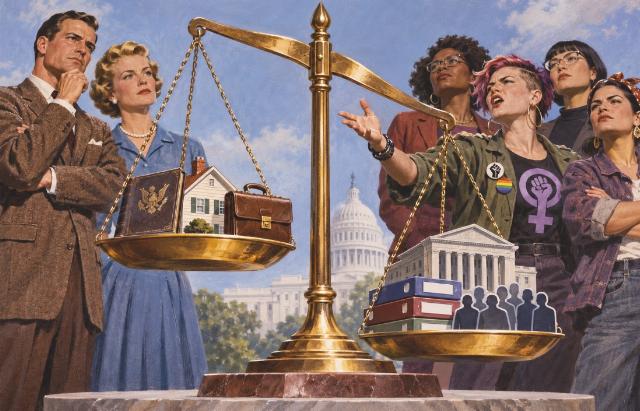
The Feminization Of America
The women’s rights movement moved from Constitutional ideas to an experiment in unintended consequences.
BY: Allan J. Feifer, The American Thinker (November 8, 2026).
In 1920, with the ratification of the 19th Amendment, America commenced an experiment whose consequences are still unfolding. Women’s suffrage was only the beginning. Over the ensuing century, women steadily expanded their influence in work, education, government, politics, nonprofits, NGOs, and institutions shaping American life. Women now outnumber men on college campuses and have begun to dominate certain institutions.
No longer a question of equal rights or opportunities, the more consequential question today is whether the growing influence of women, coupled with the rise of political feminism, has changed not merely who governs America, but the philosophy by which America is governed. Political ideology is increasingly shaping life for everyone, not just activist feminists, leading to a future that not everyone signed up for.
The Founders built a political system around individual liberty, personal responsibility, self-reliance, private property, competition, and limited government. They began with the idea that rights do not come from government; government exists primarily to secure them.
Equality must mean equality before the law and the opportunity to prosper or fail through individual effort—not government-mandated equal outcomes. One philosophy protects the individual’s freedom to succeed or fail; its antithesis treats disparities among groups as evidence that institutions should intervene to ensure particular outcomes. This schism is central to modern political feminism and the power it seeks.
The women’s suffrage movement initially aligned with the Constitution, demanding equal political rights. Second wave feminism emerged in the 1960s, initially seeking to remove barriers to women’s full participation. Again, it was constitutionally aligned. Betty Friedan’s 1963 The Feminine Mystique helped catalyze that movement. Founded in 1966, the National Organization for Women sought to secure equal rights and opportunities for women.
Later, another, more radical theme developed alongside it. Shulamith Firestone’s The Dialectic of Sex (1970), Kate Millett’s Sexual Politics (1970), the Redstockings Manifesto (1969), and Carol Hanisch’s essay “The Personal Is Political” tore into traditional gender roles, hierarchy, and the distribution of power itself: this was radical Marxist-adjacent radicalism masquerading as feminism. The objective was no longer simply equal access to existing institutions, but overturning basic assumptions about human relations, and reorganizing society around a hierarchy of victimhood.
Feminism increasingly became a vehicle for advancing a competing philosophy of social organization—one emphasizing collective responsibility, group identity, and institutional responsibility for correcting perceived inequalities. Many will recognize this as progressivism in practice: obtaining political supremacy through overthrowing existing political dynamics.
Consider how these ideas traveled into institutions. In 1970, San Diego State established the nation’s first Women’s Studies program. Within four years, it became an academic department, and the field quickly spread to universities nationwide.
Ideas developed in these programs moved into professional associations, teacher training, nonprofits, government agencies, and public administration. Graduates and faculty carried theories of patriarchy, systemic inequality, and institutional power into organizations shaping policy. What began as an intellectual challenge to traditional structures increasingly became a kind of incremental societal overwriting.
Title IX offers a revealing example. Enacted in 1972 to prohibit sex discrimination in federally funded education, it expanded women’s athletic opportunities while permitting separate men’s and women’s teams. But the law became a battleground over the meaning of sex itself.
The Biden administration’s 2024 regulations sought to extend Title IX protections to gender identity, threatening, critics argued, the sex-based distinctions protecting women’s opportunities. Courts vacated the rule nationwide, and the Education Department repealed it in 2026. The Supreme Court subsequently affirmed that Title IX permits women’s teams based on biological sex. The attempted reinterpretation showed how even a law intended to protect women could become an instrument for advancing a new radical orthodoxy.
This was no longer simply a change in administrative vocabulary. The relationship between citizens and the state became radicalized. Once unequal outcomes were presumed to demonstrate injustice, government wielded its power as a sledgehammer to correct them.
Equal treatment gives way to different (and for women, preferential) treatment in pursuit of equity. Individual responsibility becomes subordinate to collective grievance. Government, once meant to secure individual rights, increasingly became tasked with managing outcomes—modern political feminism in action.
Institutions began to push certain traits associated with women while disfavoring others. Competition, assertiveness, confrontation, risk-taking, command, and decisiveness—qualities traditionally associated with masculine leadership—are increasingly treated with suspicion under the rubric of “toxic masculinity.” Cooperation, accommodation, consensus, sensitivity, and inclusion, traditionally associated with feminine traits, have been elevated to institutional virtues.
No longer is there a balance between competing leadership models, but a profound preference for one over the other. Leadership requires saying no, accepting responsibility, confronting opposition, and making decisions whose consequences cannot be negotiated away. A government unable or unwilling to exercise authority decisively has abdicated its responsibilities to a mob, feminist in this case. This is how modern feminism works in practice: never additive; only subtracting from our rights.
Margaret Thatcher offers a useful counterexample to any suggestion that women themselves are the problem. She understood the necessity of confrontation, competition, and decisive action. Hillary Clinton, by contrast, demonstrated how a politician can struggle under pressure and make damaging tactical misjudgments, as when she described Trump supporters as a “basket of deplorables.” The contrast illustrates the difference between leadership that accepts conflict and leadership trapped in managing squishy, hard-to-measure feel-good perceptions like “It takes a village,” which is equally unassailable. These are individual, not sex-based traits.
But sometimes traits that are deeply tied to innate femininity do have political consequences. Deterrence depends on an adversary believing that a nation is willing to impose unacceptable costs and accept inherent risks. Defending liberty requires more than consensus and expressions of concern; it requires force, sacrifice, and a willingness to break things. A feminist culture that rejects confrontation weakens prospects for preserving peace and security.
Ultimately, the conflict is not just between men and women and their inherent differences. It is between competing philosophies of human organization and government. One places individual rights, responsibility, and limits on state power at its core. The other prioritizes collective welfare, group identity, and correcting unequal outcomes through institutional intervention.
These philosophies cannot peacefully coexist when one seeks to displace the other. Modern political feminism is not simply another flavor of governance that can be confined to a particular policy or balanced against competing ideas. It is an all-consuming, winner-take-all system of beliefs that brooks no rivals. Once disparities are identified, no institution, hierarchy, standard, or private decision remains beyond its reach. It is a time bomb embedded in our constitutional order.
Women’s growing influence does not, by itself, explain this transformation. Nor should every woman be expected to conform to a particular leadership style. But the bedrock tenets of modern political feminism have advanced a philosophy increasingly at odds with the Founders’ interconnected principles of individual liberty, equal treatment, personal responsibility, and limited government.
The experiment that began with women’s suffrage produced undeniable gains in opportunity and participation. But its accompanying ideological transformation has advanced a philosophy that subordinates individual rights to collective claims and equal opportunity to prescribed outcomes. A constitutional republic cannot indefinitely preserve its founding philosophy if its institutions increasingly embrace a competing one.
The question is no longer simply who governs America. It is which philosophy wins control and what it portends.
God Bless America.
____________________________________________________________________
The Character Of Freedom
A free society cannot survive when its citizens surrender the responsibilities that make freedom possible.
BY: Luis Gonzalez, The American Thinker (November 8, 2026).
Communism and the American constitutional tradition both depend on human character. The difference is what they expect from it.
Marx envisioned a classless society in which the state would eventually wither away. Once class distinctions disappeared, political authority would supposedly become unnecessary.
It was an ambitious vision of human social organization. It is a magnificent theory, provided one ignores human nature.
History has been considerably less accommodating. Governments established in communism’s name have repeatedly produced powerful ruling elites, entrusted with the authority to distribute wealth, direct labor, and decide what is best for everyone else. The promised disappearance of privilege gave way to its institutionalization. The road to a classless society has a peculiar habit of passing through a very privileged neighborhood, where the ruling class enjoys privileges unavailable to everyone else.
The problem is not difficult to identify. Concentrate enough power in the hands of a political elite, and eventually that elite discovers reasons to keep it. The people who promised to abolish class distinctions have proved remarkably successful at establishing one of their own.
The American Founders approached the problem from an altogether different direction. James Madison captured their understanding of human nature in Federalist No. 51: “If men were angels, no government would be necessary. If angels were to govern men, neither external nor internal controls on government would be necessary.”
The Founders were not in the business of finding angels. They understood that ambition and self-interest were permanent features of human nature, particularly among those attracted to political power. Their answer was a constitutional republic, with divided authority, checks and balances, and institutional restraints designed to prevent any person or faction from acquiring unchecked power.
They did not assume that rulers would be virtuous. They assumed they would need watching.
That distinction matters. Democracy, in its broadest sense, means government by the people. But majority rule alone guarantees neither individual liberty nor limited government. A majority can be every bit as capable of abusing power as a monarch or political elite. The Founders understood that liberty required more than counting votes.
They established a constitutional system designed to restrain power, including power exercised in the name of the majority.
Yet the Constitution cannot do the entire job. It can restrain the ambitions of those who govern, but it cannot manufacture responsibility among those who are governed. It can protect the conditions of liberty, but it cannot compel citizens to exercise their freedom wisely. That part of the undertaking depends on the character of the people themselves.
A republic requires citizens capable of governing themselves. Self-government means more than the right to cast a ballot. It requires personal responsibility, self-restraint, respect for the rights of others, and a willingness to accept the consequences of one’s decisions. It requires people who understand that freedom carries obligations, not merely opportunities.
This is where our political culture has begun to lose its footing.
The November 3 election offered another indication of the growing appeal of political promises built around government benefits and expanded public assistance. The Democratic Socialists of America have become a significant force in that conversation, advancing a vision in which government assumes a much larger role in the lives of its citizens. The appeal of such promises deserves attention, particularly when the responsibilities accompanying freedom receive considerably less political billing.
Freedom is not a government benefit. It is not a subscription service, a monthly entitlement, or something delivered to the doorstep by an elected official. It is the authority to make decisions, accept consequences, pursue opportunities, and build a life without asking permission from someone who considers himself your superior.
There is nothing wrong with helping people through genuine hardship. A decent society recognizes that circumstances sometimes overwhelm individual resources. But safeguards intended to help people regain their footing were never meant to become permanent arrangements. A safety net is supposed to catch people when they fall, not become their permanent address.
We want the security without the sacrifice, the benefits without the burden, and the rewards without the work. There is a profound difference between helping someone stand again and convincing him that standing on his own is no longer necessary. One preserves dignity. The other gradually replaces it with dependency.
And government is always happy to oblige. Every promised benefit creates another political obligation. Every obligation creates another constituency. Every constituency gives politicians another reason to retain the authority they acquired in the name of helping people. Meanwhile, citizens become increasingly accustomed to looking elsewhere for answers to problems they once understood were theirs to solve.
The danger is not simply that government grows. It is that citizens gradually surrender the habits of independence that make limited government possible. As responsibility moves from individuals to institutions, political authority expands to fill the space. Eventually, the machinery of the republic may remain intact while the character necessary to sustain it has deteriorated.
This brings us back to the fundamental difference between the two political traditions. Communism places its faith, in practice, in those who hold concentrated political power.
The American constitutional tradition recognizes the dangers of concentrated power and attempts to restrain it. But constitutional restraints alone cannot preserve a republic. Its citizens must be willing and able to govern themselves.
Nobody is virtuous enough to rule everyone else. And no society remains free when its people no longer believe they are capable of ruling themselves.
We can elect better politicians, write better laws, change administrations, and rewrite policies. But we cannot legislate the character required to sustain a free society. The Constitution can establish the framework. It cannot supply the people who must make it work.
A nation that forgets how to govern itself will eventually find someone willing to govern it. And that someone will rarely be interested in giving the authority back.

GFK

