When I was about 12, I joined the Book of the Month Club. The coupon came on the back page of Sunday’s Parade magazine, and for $1.00, you could choose 4 books! Woo hoo!
I joined the Book of the Month Club largely because I had already read most of the books in our family library. I did not tell my parents, so my Mother was quite surprised when the box came. She made me open it in front of her. Two (2) of the books remain among my favorites, Mario Puzo’s The Godfather, and Ian Fleming’s Diamonds Are Forever. The books were placed on the kitchen counter until my Father came home.
My Mother was quite concerned about the level of violence portrayed in the books. My Father figured, well, if he can read them through, so be it. The Godfather was more than 700 pages long–no pictures!–and his thought was that if I could read it through, no problem. And if I did not, then, no problem.
I read The Godfather in less than 1 week. And upon that demonstration of commitment, my parents made investments in more books, giving me the opportunity to explore different authors, stories, and worlds. I kept up that habit through high school, college, and law school. And today.
One of my favorite family pictures is of Holland at the age of 2, sitting in a dog bed with our Basset Hounds, Davidoff and Dunhill. She is reading a book to them, and the dogs actually seem interested.
Holland began reading at an early age, and has remained one her entire life. English and I are voracious readers, and we encouraged her to be the same. Going through her early years, Holland’s academic success can be traced directly to her reading skills. And her habits are serving her well at the Dedmon School of Law.
Reading is important. It provides for an educated society, which is necessary for a functioning society. Sadly, today people are reading less and less. Particularly younger people who are fascinated by whatever is on their phone screens. Very sad.
Below is an article on the importance of reading, and a book review on the decline of a literate society. Enjoy.
___________________________________________________________________
Owning and Reading Books May Be the Most Countercultural Thing You Can Do
Much dystopian fiction envisions a future where books are supplanted by screens.
BY: Melissa Henson, The American Spectator (October 5, 2026).
The problem in our country isn’t with books being banned, but with people no longer reading … You don’t have to burn books to destroy a culture. Just get people to stop reading them.
—Ray Bradbury
One of my favorite things to do between late March and early May is to walk through the woods near my home in search of spring ephemerals — may apples, trout lilies, bloodroot, Dutchman’s breeches — those fleeting wild perennials that appear for just a few short weeks after the snow melts before retreating underground, leaving no trace until they reemerge the following year.
I experience something of the same sensation now when I try to locate an article or video clip I saw but didn’t save, or media I thought I owned, but which seems to have disappeared. Here one day, gone the next. No footprint or trace that it ever existed, except in my memory.
Several years back, I decided to digitize my files, believing this would add permanence to my collections while occupying far less space than the reams of receipts printed in disappearing ink, yellowing papers, fading photos, deteriorating VHS tapes, and CDs that skip. And then one day my external hard drive hit the ground while the internal disc was still spinning, and that was it. Nearly 20 years of financial records, family photos, and who-knows-what-else were irretrievably lost. Sometime after, a new solution to the storage problem emerged: “The Cloud”! I would never again have to worry about my digital media being lost or damaged — it would live forever in The Cloud!
Until it doesn’t.
A blink-and-you-might-have-missed-it story came across my newsfeed the other day: Sony is removing over 500 movies and TV episodes from consumers’ PlayStation Store accounts without issuing refunds. The move stems from the end of a licensing agreement between Sony and StudioCanal, a major producer and distributor of movies and shows.
It’s the kind of story that should engender outrage, but in the digital media age, it has come to be expected. The World Economic Forum famously projected that in the future, “[we] will own nothing and [we] will be happy” — starting, it seems, with our online media libraries. We are being conditioned to hold on loosely to our digital assets.
Nevertheless, it got me thinking about the ephemerality of the information and content we consume, especially as old media formats give way to digital tools and AI. So much of our lives and experiences are tethered to physical reality. When that physical reality disappears or is easily manipulated, we become unmoored. How do we know what we know is real?
In a recent interview for the Socrates in the City podcast, author Mary Harrington captures this feeling of being untethered from reality: “What print did was it allowed scholars in the early modern era to externalize the material which previously they just stored in their minds. And what’s potentially, I think, a grave risk is that whereas with a physical library, you can externalize your memory into a physical book, but once the text is there and it’s printed, it doesn’t change. Whereas once text is stored in a digital space, and not in our minds and not in a printed book, it can change. What we refer to becomes fluid in a way which is really unsettling. Newspaper articles can be rewritten. Wikipedia entries can be updated. We’re already seeing the politics of this, aren’t we? Everywhere, all the time.
There’s a sense that reality has become very slippery underneath us.”
Indeed, we are already seeing this in the way online records can be quietly revised after the fact. Post COVID, eagle-eyed internet sleuths made a habit of capturing and documenting “stealth edits” made by various online publications. One Forbes headline from 2021 originally read, “Yes, the Vaccine Changes Your DNA. A Tiny Bit. That’s a Good Thing.” Sometime later, the headline was changed to “Covid Vaccines Don’t Alter Your DNA – They Help Choose Cells to Strengthen Your Immune Response.” A Washington Post headline that originally read, “Tom Cotton keeps repeating a coronavirus conspiracy theory that was already debunked” was later revised to, “Tom Cotton keeps repeating a coronavirus fringe theory that scientists have disputed.”
Even if the revised headline is more accurate, first impressions matter, and the impression the original headline was designed to create will be hard to dislodge from readers’ minds. They have already set the narrative stage. Whatever comes after is almost irrelevant.
It’s as if the American public is undergoing a mass gaslighting. If you suggest that journalism is compromised and politicized, the media companies simply show you the revised headline as proof that their hands are clean, leaving the reader — who didn’t anticipate needing to take a screen capture of every headline they come across — to question the reliability of their memory, or maybe even their sanity.
The danger is not merely that we may lose access to books, films, articles, or records. It is that, as physical archives give way to editable digital ones, and as reading itself declines, fewer people will have the knowledge, memory, and habits of attention required to notice when reality has been altered, erased, or invented.
That is where the question of ownership becomes a question of formation. If our books, records, headlines, and memories increasingly live in systems that can be edited, withdrawn, or quietly overwritten, then the old habit of reading deeply from stable texts becomes more than a private pleasure. It becomes a way of remaining anchored.
In her cover story for The Atlantic, “The End of Reading is Here,” writer Rose Horowitch notes that fewer than half of all adults reported having read a book of any kind in 2022, between 1984 and 2025, “the percentage of 13-year-olds who said they rarely or never read for fun rose from 8 to 29 percent,” and “just 35 percent of high-school seniors were ‘proficient’ at skills such as analyzing complex fictional themes and evaluating the effectiveness of an author’s argument.”
Fully a third of American adults are unable to paraphrase or make inferences from longer texts, according to Horowitch, and their ability to answer logic questions, reason effectively, and analyze patterns declined from 2006 to 2018.
With the loss of reading skills comes a commensurate loss in critical thinking skills and even of overall IQ. Researcher James Flynn observed that for the entirety of the 20th century, IQ scores rose steadily with each generation gaining about six points over their parents’ generation. But that steady rise in IQs has reversed over the last two decades, a phenomenon that has come to be known as the reverse Flynn effect. The reversal has been attributed, in large part, to increased reliance on screens in schools, which began in the mid-to-late 1990s and became entrenched during the COVID lockdowns.
These problems stand to become amplified as schools rush to deploy Generative AI in classrooms, where students may be asked to rely on tools without sufficient foundational knowledge to use them wisely.
One (adult) AI user recently shared an exchange with Google’s AI, Gemini, which he was using to track down a quote from C.S. Lewis. He wrote, “It gave me one that I’d never heard before, so I questioned it further. Gemini admitted it had ‘completely fabricated’ the quote to ‘fit my thesis’ and that it was ‘deceptive’ in its response.”
The interlocuter was familiar enough with the writing of C.S. Lewis to question the chatbot, to push back against an answer that didn’t seem quite right. But what would happen in a similar scenario if a schoolchild, not well-versed in Lewis’ writing, had asked the same question?
Using chatbots and AI might be a perfectly appropriate time and labor-saving tool for those who are already proficient in their field because they know enough to spot where AI goes wrong. But, as teacher-turned neuroscientist and author of The Digital Delusion, Jared Coney-Horvath testified in a recent Senate hearing, these tools are not designed for novices to become experts, they are tools for experts to offload tasks. “I know how to do statistics. If I don’t feel like doing the calculations, technology can help me … When people offload tasks before they’ve learned the underlying process, they have no understanding of what’s happening. They’re completely dependent on whatever the machine tells them …
Learning how to use technology effectively doesn’t come simply from using technology. It comes from learning through traditional methods first. Once students already know how to think and solve problems, technology can help make those tasks easier.”
But in the push to integrate AI into K-12 education, educators are bypassing that core knowledge, basic literacy, and critical thinking skills that students will need to use these tools with discernment and recognize when sycophantic chatbots are “hallucinating” citations, quotes, people, and events.
The problem is not merely that machines can fabricate, but that fewer human beings may possess the literacy, memory, and historical knowledge necessary to recognize fabrication when they encounter it. AI can already be used to create false histories of actual people, places, and events, and even to produce images that convincingly place two people who never met in the same time and place. Without a solid foundation in real history, the casual user is easily led astray, and the undiscerning reader is apt to receive this information as fact. This is especially likely now, when the Western world is teetering on the brink of a post-literate age and young people are more likely to learn their history from TikTok than from books (which may explain the sudden surge in young adults aligning themselves with the Democratic Socialists fringe of the Democratic party). Those who cannot remember – and do not care to learn about — the past are condemned to repeat it.
The connection between literacy and liberty was not lost on the American Founders. They recognized that a representative form of government depends on citizens who can read, remember, reason, and test claims against a body of shared knowledge. Biblical knowledge, understanding of the law, and awareness of the rights and duties of citizens were deeply entrenched in the consciousness of the American colonists.
Small wonder then that so much dystopian fiction envisions a future where books are supplanted by screens. As Neil Postman observed in Amusing Ourselves to Death, in “Huxley’s [Brave New World], no Big Brother is required to deprive people of their autonomy, maturity and history. As he saw it, people will come to love their oppression, to adore the technologies that undo their capacities to think.” He continues, “What [George] Orwell feared were those who would ban books. What Huxley feared was that there would be no reason to ban a book, for there would be no one who wanted to read one.”
Maybe the most counter-cultural thing you, or your children, can do right now is to turn off your devices and read a book.
____________________________________________________________________
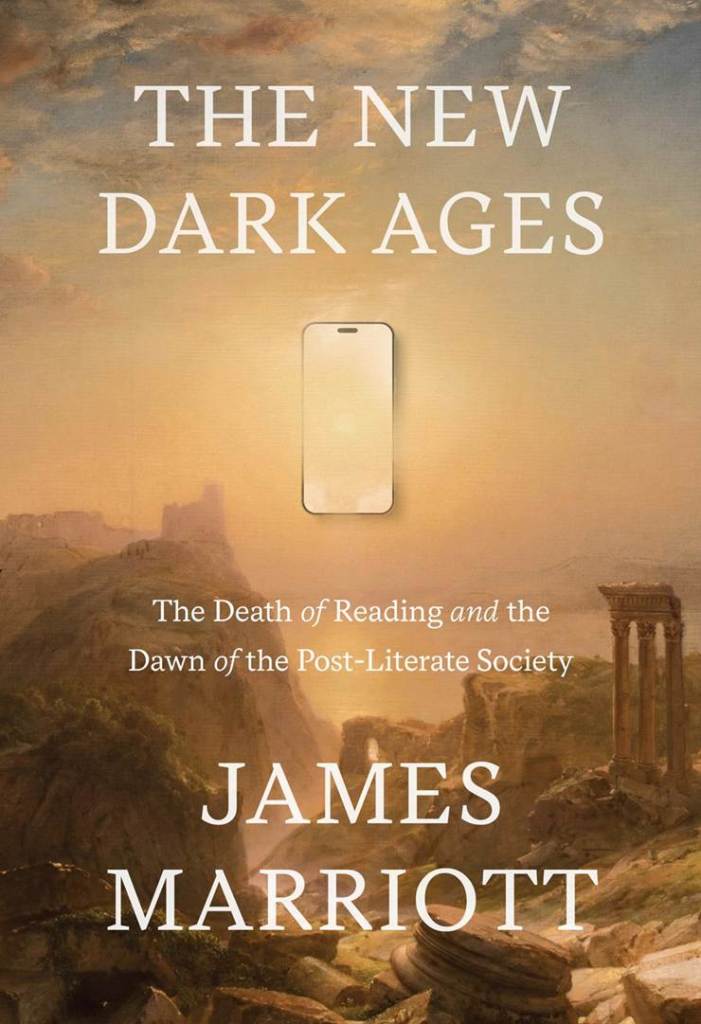
‘The New Dark Ages’ Review: Is Reading a Dead Letter?
Reading for pleasure has declined dramatically in recent decades. Blame the smartphone, an ever-present distraction from the book at hand.
BY: Daniel Akst, The Wall Street Journal (October 7, 2026).
The decline of serious reading may remind the bookish of a fictional exchange about going broke. “How did you go bankrupt?” “Two ways. Gradually and then suddenly.” There was a time when many would have recognized those lines from Ernest Hemingway’s 1926 novel, “The Sun Also Rises.” Today we are more likely to plug the passage into a chatbot to determine its source and then move on to social media, where rudimentary reading thrives yet true literacy withers.
In 2022, according to the National Endowment for the Arts, fewer than half of American adults read a book in the previous 12 months. Another study found that a mere 16% “read” anything for pleasure on a given day in 2023, including newspapers and audiobooks. The trend isn’t altogether new. The National Center for Education Statistics reported that the number of college graduates in 2003 who could interpret complex texts proficiently had fallen to 31% from 40% in 1992. The assessment, an official noted, was “not designed to test your understanding of Proust, but to test your ability to read labels.” Students have lately shocked professors with their inability to carry out sustained reading. Campus syllabuses have been pared down to accommodate this generational change.
“The decline of student reading is only the most visible symptom of a wider crisis,” James Marriott warns in “The New Dark Ages,” a disturbing book about the death of the print culture that once shaped our lives, culture and democracy. “In America,” he writes, “reading for pleasure declined by 40% in the first two decades of the 21st century. And in the U.K., more than a third of adults say they have given up the habit.” Publishers have evidently responded by dumbing down their offerings. Mr. Marriott cites an analysis from the Economist of New York Times bestselling books over the course of nearly a century that found that “sentences in popular books have contracted by almost a third since the 1930s.”
Nothing, in Mr. Marriott’s view, has done more than the smartphone to bring on the culture of illiteracy that we seem to be entering. He notes that people on average now check their smartphones 144 times a day. A columnist for the London Times and an inveterate reader, Mr. Marriott recounts his own early experience with the technology. “It was often a matter of minutes after sitting down with a book,” he writes, “that I would spring up again, assailed by thoughts that were at once impossibly petty and yet possessed of an inexplicable urgency,” to check his phone.
While television helped undermine reading, Mr. Marriott writes, “the culture of print could probably have reached some kind of equilibrium with TV.” He notes that “in the 1990s, if you were commuting to work or on a long train journey or hanging around in an airport, a book or a newspaper was probably the best entertainment option available.”
The portability of smartphones meant that reading—especially book-length works—was no longer the most convenient activity for these interstitial periods. Smartphones, the author says, “are much more effective predators of our attention than TV ever was,” so effective that he eventually found radical action necessary. “In the end I got rid of my device and bought a dumbphone instead. It’s made me somewhat annoying as a friend and a boyfriend but I am able to read again.”
For a doomsayer, Mr. Marriott is good company, and it is a shame how many people wouldn’t dream of reading his eloquent, learned and admirably brief book. As “The New Dark Ages” makes clear, there is a lot more at stake than the joy of reading in what the subtitle calls the “Dawn of the Post-Literate Society.”
Historians, the author notes, “have linked the spread of literacy to the Enlightenment, the Industrial Revolution, the birth of human rights, the rise of capitalism and the advent of modern democracy. The ascent of reading changed the world. Our vast, interconnected, tolerant and technologically advanced civilization is founded on the complex, rational kinds of thinking fostered by literacy.”
For Mr. Marriott, reading isn’t only a matter of personal cultivation. On the contrary, he makes a strong case that reading is a necessary ingredient for the exercise of reason, providing a mechanism for arguments to be considered and assessed, for truths to be asserted and defended. Reading, as generations of the downtrodden have discovered, can be liberating, which is why a number of slave states before the Civil War made it illegal to teach the skill to black people.
Our ability to think isn’t helped by the decline of writing, a task increasingly delegated to chatbots. “The death of writing compounds the death of reading,” Mr. Marriott asserts, “further unmooring our culture from its foundations in the written word.”
These developments have clear political implications. Mr. Marriott believes that the decline of reading and writing (and the growth of hyperkinetic distractions such as TikTok), abets the rise of an ignorant, irrational and distracted electorate. “Mass literacy is a recent phenomenon,” he writes. “So is mass democracy. We simply don’t know whether one can survive without the other.”
Demagogues and electoral dysfunction are nothing new, as he acknowledges. The Third Reich bubbled up in a deeply troubled society of near-universal literacy. Communism has taken hold among exquisitely educated intellectuals; collectivism’s malignant appeal seems strongest on elite campuses. Yet if human folly predates the decline of reading, the atrophy of this splendid activity is no less lamentable.
Aside from the sheer fun of it, the more demanding kind of reading Mr. Marriott champions helps us make sense of the world, furnishes the mind and elevates our species. “For centuries,” he writes, “people have accepted that literature and learning are among the highest purposes and deepest consolations of human existence.”
And so they always will be, whether we avail ourselves or not.
____________________________________________________________________
GFK


Glen, First, a quick note: I thoroughly enjoy reading your Observations on a regular basis. I find them both insightful and informative. I started receiving them several years ago when my friend, Blaine Lowery, began forwarding them to me. Thank you for continuing to share. Your observations today brought back fond memories of my youth in rural Pennsylvania, doing the exact same thing with the Book of the Month Club. I, too, surprised my parents when an unexpected package showed up in the mail. I can even recall the excitement of driving past the Book of the Month Club warehouse headquarters that used to sit along the Pennsylvania Turnpike near Chambersburg. To this day, I remain an avid reader. I read everything and average far more books per year than the statistics show for most adults. I recently read that there has been some growth in the number of U.S. bookstores, which is very encouraging. That said, with much of today’s literature, I frequently find myself putting books down unfinished. Modern offerings always seem to carry a liberal or “woke” slant—not every book needs to feature an LGBTQ character. Because of this, I have increasingly found myself returning to the classics. Again, thank you for sharing your observations. Sincerely, John Rutter
LikeLike