Some thoughts on the passing events of the day. We offer comments about the doom and gloom crowd, the genius of Ronald Reagan, and our nation’s Constitution. Please enjoy.
____________________________________________________________________
We Are So Tired of the Loudmouth Quitters
BY: Kurt Schlicter (September 28, 2026).
Every election cycle we hear the same stupid spiel from a certain band of pseudo-conservative quitters: “Oh no, I’m not getting my way. I’ve got no reason to vote. I’m not going to vote. The Republicans aren’t conservative enough, so I’m just going to let the communist pervert Democrats win. Waa, waa, waa.” I don’t know whether this is tactical stupidity or a cry for attention — maybe it’s both — but it’s exhausting. Boss, I’m tired.
Tired of the ostentatiously blackpilling pundits and posers who think electing Democrats by sitting out the election is the way to morph the Republican Party from a bunch of crony codgers managing America’s decline like gentlemen into a party that’s making America great again. It’s not. You never win by losing. And in fact, we’ve been winning. If you’re mad because you think Donald Trump hasn’t performed, you’re not thinking at all. The only question is whether that’s because you can’t or you’ve chosen not to.
“But Kurt, we’ve got to teach the Republicans a lesson!” Yeah, we do. Do you think the Republicans haven’t learned anything? What’s Sen. John Cornyn (R-TX) going to be doing after January? The answer is nothing. He’s not going to be doing anything because, after he voted for gun control and hinted at support for amnesty even as he awkwardly donned a Stetson to fool the Lone Star rubes, the Texas GOP decisively fired him. Ask tofu-spined Sen. Bill Cassidy (R-LA) what he’s going to be doing. Again, nothing. The squish got squashed. How about the ridiculous Sen. Thom Tillis (R-NC)? He didn’t even bother running because he knew he’d get drop-kicked into oblivion in the North Carolina primary.
Oh, and of course there’s that fake-libertarian doofus Republican Rep. Thomas Massie (KY-4), whom most of these dim doomers probably adore, who got his walking papers in the primary. Now he’ll have time to finally get around to disclosing that Epstein list he keeps running his fool mouth about — that is, when he’s not blaming all his problems on the Jews.
The fact is that we are getting rid of the deadweight. We are making progress. The Republicans are learning their lesson. That’s what primaries are for. That’s what the primaries have done. But what the general election is for is stopping the communists. This is when it counts. This is when it matters. Yet a bunch of prima donnas — mostly on social media, because I haven’t actually met any of them in real life — are announcing they’re going to be AWOL because they didn’t get their way. They want to quit while we’re ahead.
Yeah, I know gas is too expensive. Get over it. Yeah, I know Donald Trump is fighting a war that we should’ve won 30 years ago and that bothers some people. But defeating a generational enemy and preventing it from being able to drop a hot rock on New York — again, a lot of these doomers probably wouldn’t mind the mullahs nuking Tel Aviv because, you know, the Jews — is a good thing. Donald Trump knew he was risking his majority and did what he had to do anyway. We should be proud of him, not act like whiny little teenage girls, pouting in our rooms and desperately scribbling our gripes and complaints in our figurative dream journals.
I just can’t deal with people who are so dumb, or so disingenuous, that they would actually argue that we must protest the Republicans not being conservative and populist enough by electing a bunch of perverted communist weirdos who want to castrate kids, throw open the penitentiaries, invite in the entire Third World, and persecute anybody to the right of
Democrat Rep. Alexandria Ocasio-Cortez (NY-14). Burn it all down? It’s our house! We’ve got all three branches of government. Did we get everything we wanted from Congress? No. And you know what? We’re never going to get everything we want from Congress. We’re never going to get everything we want from any institution. Because we’re adults — at least some of us — we understand that you don’t always get what you want.
But we have gotten a lot, all of which this nonsense strategy of sitting out the midterms puts at risk. See the border? It’s closed. What kind of idiot would think it’s a great idea to give power to the people who want open borders in order to protest Donald Trump not deporting quite enough illegal aliens so far? And you’re mad about gas prices? Do you think the party that hates fossil fuels, that wants us riding buses with homicidal hobos or pedaling bicycles like ponytailed gender-studies TAs, is going to make for lower gas prices?
They’re going to shut down our entire petroleum industry. Do you think that’s going to make gas cheaper, Einstein? In what universe do you live? Did you think this through?
Once again, we’re faced with the classic “stupid or thinks you are stupid” conundrum: Are they really dumb enough to think that’s a good plan, or do they just think you’re dumb enough to think that’s a good plan? Be mad – good, you should be. But be smart.
Like I said, we get the same ostentatious opt-out announcements every cycle. Once upon a time, I would try to gently reason with people like this. I would provide them evidence and facts showing that choosing defeat was not the best path to victory, either short-term or long-term. But cycle after cycle, we get the same loud, stupid people on social media who stand up and advocate failure as the key to success. You can’t argue with an idiot because he’s an idiot. And you can’t argue with somebody whose purpose is only to draw attention to himself. I don’t want to put these people in the spotlight; they’re political narcissists who want us to beg them for their support. I guess it gives them some sort of meaning, and the attention gives them the false impression that they matter.
There are demoralized Republicans out there, so there’s a market for dooming. It’s easier to exploit them than to energize them. Sadly, social media pays a premium to loudmouth posers who try to draw attention to themselves by taking obnoxious positions, like not voting in the general, as some sort of dimwitted protest. You just need a relatively small slice of the media pie to be successful, and the slice these guys are aiming to claim is topped with a heaping dollop of strategic stupidity.
“But Kurt, Congress hasn’t done anything!” Yes, it has. Putting the Big Beautiful Bill, a bunch of judges, and things like the Laken Riley Act aside, it has stopped all sorts of horrific Democrat initiatives. “But Kurt, we haven’t jailed all the Obama/Biden crooks, we haven’t deported every single illegal alien, and we aren’t guaranteed ponies at Christmas!” All true. In any human endeavor, you don’t get everything you want all at once. You make compromises. You set priorities. You win some, and you lose some.
Don’t be mad at me for telling you that — be mad at whoever told you differently, because they lied to you. So grow the hell up and stop acting like a bunch of sissies.
Now, I’m going to get a lot of grief about this column because I’m allegedly not taking legit complaints and dissatisfaction seriously enough. What they’re really mad about is that I’m not sufficiently catering to their caterwauling because they have to pay another buck at the gas pump to make sure we all don’t glow in the dark. Oh, do they need a hug? Well, this isn’t the time for hugging. This is the time for voting. This is the time for doing what you have to do to win in the long run. No, gritting your teeth and marching forward doesn’t provide the giddy emotional satisfaction of a temper tantrum. But then, adults aren’t out for emotional satisfaction. They’re out for victory. And the only way we’re going to have any chance of winning our country back is by defeating the communists who want to destroy what’s left of it.
So to those of you who want me to beg you for your support, here’s some sand. Feel free to pound it. I’m not going to pretend that anybody out there urging us not to do everything we can to win this midterm election — one where the deck is already historically stacked against us — is anything but a clown.
Life is hard. So is ensuring our freedom. Get over it and get to work.
____________________________________________________________________
Ronald Reagan’s Warning for Washington in 2026
BY: Larry O’Connor (September 25, 2026).
Ronald Reagan believed ordinary Americans could be trusted with their own freedom. In 2026, that increasingly feels like a radical proposition.
There are plenty of reasons why conservatives still talk about Ronald Reagan nearly four decades after he left office. He won 49 states. He rebuilt the military. He helped win the Cold War. He cut taxes and, maybe most importantly after the miserable 1970s, reminded Americans that there was nothing wrong with believing America was a pretty great country.
But I think we’ve turned Reagan into a highlight reel over the years.
We remember the speeches, the landslide, and the jokes. We remember “Morning in America.” We remember him telling Gorbachev to tear down the Berlin Wall.
What gets lost is the idea beneath it all.
Reagan trusted people.
That sounds ridiculously simple, but look at our politics in 2026 and ask yourself how many people in Washington really believe it anymore.
On June 12, 1987, Reagan stood at the Brandenburg Gate in West Berlin and delivered the line everybody knows:
“Mr. Gorbachev, tear down this wall!”
We’ve heard it so many times that it’s easy to forget how extraordinary it was to say at the time.
The Berlin Wall was still there.
Communism wasn’t something safely tucked away in a history textbook. The Soviet Union was very much alive. Millions of human beings were living under communist governments, and the experts had spent years telling us that this was simply the world we lived in. The Soviet Union wasn’t going anywhere. East Germany wasn’t going anywhere. The wall certainly wasn’t going anywhere.
Reagan didn’t buy it.
He also didn’t feel compelled to pretend that the two sides were morally interchangeable.
One system had to build a wall to keep its own people from escaping. That pretty much told you everything you needed to know.
Two years later, Berliners were standing on top of that wall with sledgehammers.
Reagan understood that freedom occasionally requires somebody to say the obvious out loud, especially when all the smart people have decided saying the obvious is unsophisticated.
There’s a lesson there for conservatives today.
We have become so accustomed to political language being run through consultants, pollsters, communications teams, and focus groups that politicians can speak for 20 minutes without risking an identifiable thought.
Reagan could certainly be diplomatic. But he also understood there are moments when clarity matters more than cleverness.
America is good.
Freedom is better than tyranny.
Communism is evil.
People should be free to run their own lives.
None of this required a white paper.
And Reagan applied that same basic principle at home.
Six years before Berlin, in his first inaugural address, he asked a question that ought to be printed over the entrance to every federal building in Washington:
“If no one among us is capable of governing himself, then who among us has the capacity to govern someone else?”
That’s a devastating question because Washington still doesn’t have a very good answer.
Instead, the federal government has spent the ensuing decades accumulating responsibilities that once belonged to states, communities, families, and individuals.
Washington increasingly tells us what kind of car we should drive, what appliances we should buy, how businesses should operate, what schools should teach, and how
Americans should spend the money they earn.
There is always a perfectly reasonable explanation.
There is always an emergency.
There is always an expert.
And somehow the answer always seems to involve giving somebody in Washington a little more authority over your life.
Reagan wasn’t arguing that government was unnecessary. He said explicitly in that 1981 address that government has important functions. His argument was about where government gets its authority in the first place.
From us.
That distinction seems obvious. It is also the heart of the American experiment.
And conservatives should be careful about forgetting it simply because we’re the ones temporarily holding political power.
Limited government isn’t a principle that applies only when Democrats are running it.
If conservatives spend years complaining about an enormous federal government and then decide our real objection was merely that the wrong people were operating it, we’ve learned precisely the wrong lesson.
Government power doesn’t become harmless because somebody with an “R” after his name is exercising it.
There is another side to Reagan’s argument that doesn’t get nearly enough attention.
Self-government requires self-government.
Freedom comes with responsibilities. It requires adults who are willing to take care of themselves, raise their children, help their neighbors, build businesses, support churches and charities, participate in their communities, and solve problems without immediately demanding that Washington create a department to handle them.
That’s harder.
Dependency is easier.
But a nation of people who surrender every responsibility to government shouldn’t be surprised when government eventually starts treating them like children.
This is where Reagan’s challenge from Berlin and his question from the inaugural address meet.
Both were statements of confidence in human freedom.
The people trapped behind the Berlin Wall deserved the freedom to determine their own lives.
So do we.
The question for conservatives in 2026 isn’t whether we can find another Ronald Reagan. We aren’t going to.
The better question is whether we still believe what he believed.
That America is worth defending. That freedom is better than government control. That Washington works for us, not the other way around.
And, most importantly, that Americans can still be trusted with the responsibility of being free.
____________________________________________________________________
A State’s Right to Secede
BY: Mark Lewis (September 22, 2026).
“If the states do not have the right to secede, then they have no rights at all.” — Dr. Walter Williams
Dr. Williams is one of the few men I’ve ever read who understood the American Constitution. That marvelous document has been so warped all through U.S. history that very few Americans truly understand what our Founders did in the Constitution. It isn’t going to change any time soon, and Dr. Williams’ statement is probably shocking to many. Let’s look at it.
The Declaration of Independence created 13 “free and independent states”; it did not create the United States of America (read it). Those states (colonies under England) jealously guarded their individual colonial rights and privileges. When they declared independence, leading minds convinced most colonists that there were certain matters (like fighting a war) that were better accomplished collectively than individually. Many, many of the new Americans were very suspicious of any nationalized government (that was, remember, the very thing they were rebelling against), but enough of them went along with it to establish the United States, and finally, in 1789, provide a constitution for the new nation. That Constitution went into effect only when nine of the states ratified it; the other four didn’t have to, but they eventually did. Each state voluntarily joined the American Union; none of them was forced in, and none of the subsequent 37 states have been “forced” to join the Union, either. That wouldn’t be freedom if they had.
In that 1789 Constitution, the “national” government was allowed very limited power. Congress, the only branch with the authority to make laws, was given only about 17 powers (read Article 1, Section 8); that’s all. The powers of Congress, the president, and courts were clearly defined in the Constitution. And just to make sure Congress stayed within its authorized powers, a Bill of Rights, the first 10 amendments to the Constitution, was added in 1791 to tell Congress what it could not do. The last of those 10 amendments specifically proclaimed that any power not “delegated” to the “United States” belongs to the states or the people.
James Madison, who basically authored the Constitution, said that the federal government’s powers were few and defined; the powers that resided in the states were many and indefinite. It made perfect sense. The states were closer to the people; thus, theoretically, they should be more responsive and aware of their needs. A one-size-fits-all protocol probably wouldn’t work in a country as geographically, economically, and ethnically diverse as the United States.
So, 13 (eventually 50) states voluntarily joined the Union. They were given most of the governmental rights, and the federal government was not to infringe upon those rights. A contract. But power being what it is — even in the hands of Americans — the feds did, indeed, begin to usurp certain rights that belong only to the states. In other words, the federal government broke the contract. What recourse did the states have? Only submission to tyranny?
No, as Dr. Williams said, they had the right to secede if they (eventually) so chose. If they didn’t (don’t), then they really have no rights at all. If all they can do ultimately is submit to whatever Washington, D.C., tells them to do, then what is “states’ rights”? A state only has a “right” if the federal government allows it to have it? That’s not states’ rights; that’s tyranny.
Undeniably, throughout American history, states have abused their powers at times, but I encourage readers to peruse Article 1, Section 8 in the Constitution and show me where 99 percent of what Congress spends money on today is found in those defined powers the Constitution gives it. States haven’t abused their powers nearly as often as Congress has abused its. And every abuse of congressional power is tyranny against the states and the people — taking away a right the Constitution gives only to the states and people.
And when one denies the states have a right to secede against tyranny, then…well, there remains only a tyrannical, totalitarian national government.
Did our Founders have a “right” to secede from England? Did Texas have a “right” to secede from Mexico? Did the Southern states have a “right” to secede from the United States? We may not — and shouldn’t — like slavery, but that’s a different question. Actually, “freedom” would mean a people have the right to secede from their country for any reason. Jefferson in the Declaration: Government’s “just powers” are created by and given from “the consent of the governed.” What can the “governed” do if they no longer “consent” to the government? If they are unwillingly forced to remain in a union they no longer “consent” to, they are no longer “free” to govern themselves. That’s a total denial of the Declaration’s main point. If the American colonists could secede, why can’t the states?
So, yes, if states have no right to secede, they ultimately have no rights at all, except whatever the national government allows them. That’s not the American Constitution, that’s Communist China.
So, that’s why the Democrats…
Disagree with Dr. Williams? Check out Abraham Lincoln: “Any people anywhere, being inclined and having the power, have the right to rise up, and shake off the existing government, and form a new one that suits them better. This is a most valuable—a most sacred right—a right, which we hope and believe, is to liberate the world. Nor is this right confined to cases in which the whole people of an existing government may choose to exercise it. Any port of such people that can, may revolutionize, and make their own, of so much of the territory as they inhabit. More than this, a majority of any portion of such people may revolutionize, putting down a minority, intermingled with, or near about them, who may oppose their movement.”
Unless, of course, they do it when Abraham Lincoln becomes president.
____________________________________________________________________
Our Non-Constitutional Form of Government Is Dysfunctional
It’s past time for our government to return to its roots.
BY: Allan J. Feifer, The American Thinker (September 23, 2026).
Much of the general malaise gripping our nation stems from a growing consensus that our form of government no longer fits the task. While we can still trumpet that we have the best form of government compared with other major pluralistic countries, we can no longer describe ourselves as nimble, efficient, and effective at the scale and speed of today’s problems, technologies, and social pressures. I can distrust government while still accepting its necessity. Is it too much to ask that government actually serve our citizens more than it serves itself?
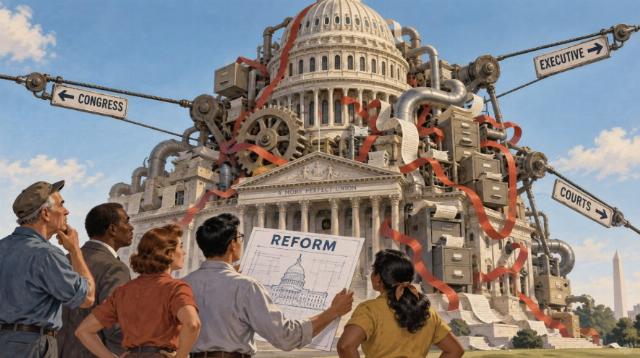
America’s problems aren’t because our constitutional system is obsolete, but because we have expanded government to a point where clarity, accountability, and adaptability have disappeared. We still possess one of the world’s most admired constitutional frameworks, yet it struggles to decide, execute, correct, and adapt. The result is not merely bad government, but incoherent government.
How Government Became Incoherent:
The Constitution was designed for a smaller, more limited republican form of government. Over the last century, government expanded dramatically. Agencies, regulations, entitlement programs, administrative bodies, contractors, commissions, and layers of bureaucracy accumulated without meaningful pruning. New problems generate new institutions, while obsolete ones linger. Complexity grows; accountability disappears.
The separation of powers was meant to prevent tyranny, not lead to paralysis. Congress increasingly abdicates its responsibilities, with the Judiciary filling the vacuum, often forced to step in to settle government dysfunction. The result is a bitter struggle among the branches. Each can obstruct the others, but none can compel coherent action.
Bureaucracies outlast administrations. Agencies write rules, interpret statutes, enforce regulations, and develop their own interests. Leadership changes, but the machinery persists. When authority is diffuse, responsibility disappears. Competing jurisdictions cling to power regardless of cost or consequence. Pogo had it right: We have met the enemy, and he is us.
What’s most troubling is that many involved—from elected officials and ordinary citizens to bureaucrats—recognize the problem but avoid doing anything about it, like the proverbial third rail. Those who benefit from the current system have little incentive to change it.
What Incoherent Government Produces:
Systemic dysfunction creates fertile ground for waste, fraud, corruption, and incompetence. Many in government know where the bodies are buried, but incentives overwhelmingly favor silence. Whistleblowers are punished while contractors, lobbyists, agencies, and politicians operate freely. Budgets are judged politically rather than operationally, and programs develop constituencies that make them nearly impossible to eliminate. Waste need not be intentional to be corrupt; misaligned incentives produce bad outcomes and unwitting accomplices.
The recent news of a federal crackdown on pandemic-era fraud is even more concerning: the government formally suspended roughly 870,000 borrowers from receiving future federal assistance through SBA loan programs; one of an endless number of revelations! A source at the FBI told me privately that many of these cases would likely be prosecutable, but that DOJ could not handle numbers this high; hence, banning was the remedy chosen. We should keep in mind that the 870,000 number is the tip of the iceberg; over 19 other pandemic programs are under intense fraud scrutiny, plus dozens more elsewhere.
Technology has exposed the problem even more clearly. Modern problems move at technological speed: cyberwarfare, AI, financial markets, pandemics, energy systems, social media, drones, biotechnology, and global supply chains. Private organizations adapt in months. Government takes years, if it adapts at all. The mismatch between the world’s speed and government’s speed is the core danger. We see this playing out right now in the AI debate.
Dysfunction Changes the Public:
Citizens watch government fail and lose trust. They become receptive to movements promising dramatic solutions, even when those solutions would fundamentally alter the system they once trusted. Americans who favor limited government can be drawn to radical alternatives when conventional government seems incapable of solving problems.
People begin asking whether constitutional government itself is the problem. Dysfunction makes the extreme seem reasonable.
This creates a dangerous feedback loop: dysfunction produces distrust; distrust produces extremism; extremism produces institutional resistance; resistance produces deeper dysfunction. As government appears to fail, citizens become more receptive to factions whose rhetoric sounds reasonable in the moment. Institutions then respond defensively, producing even more gridlock and frustration.
The Democratic Socialists of America offers a current example of how dissatisfaction can connect to a broader political alternative. DSA advocates replacing the two-party system and making radical changes to institutions including Congress, the presidency, and the Supreme Court. The point is not that DSA caused dysfunction, but that dysfunction creates political conditions in which sweeping structural alternatives become easier to sell.
Reform, Not Revolution:
The uncomfortable truth is that the solution rests with the very people who created the dysfunction. Our system was purposely limited to enumerated federal powers. Article I, Section 8 defines Congress’s principal powers, while the Tenth Amendment reserves undelegated powers to the states or the people. This is where we went off the rails.
The Constitution has not failed us; our institutions have. We have layered government to the point where constitutional machinery is collapsing under its own weight. So how do we force Congress to take responsibility instead of punting on all the hard choices? How do we simplify regulation, measure performance, establish clear authority, and hold someone accountable when things go wrong?
Programs should face periodic review based on need, cost, and performance. Agencies should have defined missions and measurable results. Authority must be paired with responsibility.
The frustration is understandable. At times, the temptation simply to tear the whole thing down can be powerful. But before Americans choose revolution over reform, they ought to understand what revolution would mean.
The real answer is straightforward: demand that government do what the Founders intended and rescope it aggressively to accomplish that vision.
To do so, the people must insist. Without that mandate, we will fail. With it, nothing can stop us. The immediate challenge is leadership willing to commit to that mandate—a modern version of Newt’s Contract with America, but aimed at making government smaller, simpler, more accountable, and effective.
Making that happen will require more than legislation. It will require making government reform important to ordinary Americans. Lower costs, fewer regulations, faster government, less waste, and someone actually being held accountable are things people can understand. The public needs to see, in real time, that reform can put money back in their pockets and make their lives easier and more affordable.
That is how we defeat the forces exploiting our dysfunction. We don’t need to abandon constitutional government. We need to make it work again. If those who want to tear down the system can make their ideas compelling, so can those who want to restore it. The choice is ours: revolution—or reform. I know which side I want to be on.
God Bless America.
GFK


The best edition in a while. Sure do miss President Reagan.
John M. Jordan, III
Hawkins-Graves, Inc.
13432 Wards Rd
Lynchburg, VA 24501
(866) 847-7703(866)%20847-7703 Toll Free
(434) 847-7703(434)%20847-7703 Office
(434) 847-7707(434)%20847-7707 Fax
(434) (434)%20942-0822 942-0822(434)%20942-0822 Mobile
http://www.hawkinsgraves.comhttp://www.hawkinsgraves.com/
LikeLike