“Never underestimate the power of prayer in the fight against evil.”
–St. Michael.
Today’s the local Chamber of Commerce golf tournament. My mogul client has put together a powerhouse of a team. Our goal is to finish. Even if we are last. We just do not want to be stranded on the back 9 with no way to get home.
____________________________________________________________________
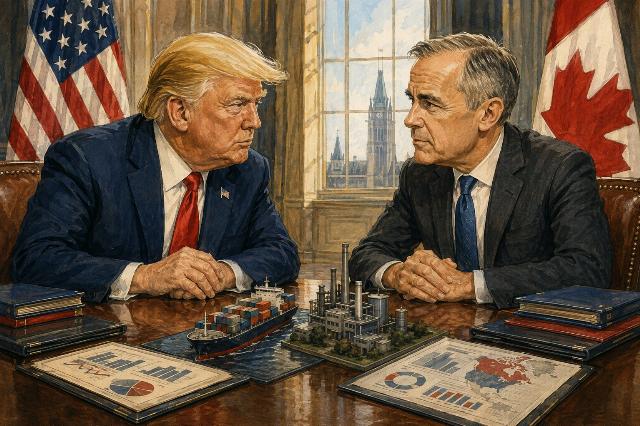
The President has imposed retaliatory tariffs against Canada, effective January 1, 2027. Canada responded by claiming it was “attacked” and that it was not at “war” with the United States, and would impose additional tariffs effective this September. Naturally, the Democrats, mainstream media, and the Never Trumpers are blaming all this on Mr. Trump. Is that fair? Is that accurate? No, and no.
Today I present several commentaries on this dispute. I submit that if you read these pieces, you will see how very deceitful Mr. Trump’s critics are being in their arguments.
____________________________________________________________________
Trump’s Canada Tariffs Aren’t the Betrayal Ottawa Claims
Mark Carney says Washington ambushed an ally. But Canada’s protected markets and dependence on US trade tell a different story.
BY: Brabim Karki, The American Spectator (August 23, 2026).
Every diplomatic breakup produces two stories, and the one Ottawa is telling that Washington ambushed a trusted partner at the negotiating table has already won the sympathy of most of the press. It is a good story. It is also incomplete.
What actually happened last week is that trade talks fell apart because the United States asked Canada to accept terms Canada found uncomfortable, and Canada refused. Prime Minister Mark Carney called the American position “unfair” and “uneconomic.” He may be right that it was tough. He is wrong to suggest that toughness, on its own, is grounds for outrage. The United States has run a trade relationship with Canada for decades that gave Ottawa nearly unrestricted access to the world’s largest consumer market while Canada kept its own protections, most notoriously its dairy supply management system firmly in place. Donald Trump’s blunt framing on social media, “Canada wants the benefits of being a State, without being one,” is crude. It is not wrong.
Trade relationships built on one side’s permanent tolerance of the other’s protections were never going to last forever.
Trump’s tariffs are not an act of aggression against an ally. They are the predictable consequence of a negotiation in which one side finally stopped accepting asymmetrical terms it had tolerated for years.
The asymmetry Trump is pointing to is real, not invented. Canadian dairy tariffs on U.S. products have run well above 200 percent under the country’s supply management regime, even as Canadian goods flow south with comparatively modest friction. American dairy farmers in Wisconsin and New York have complained about this for a generation, through Republican and Democratic administrations alike. Trump did not manufacture this grievance. He inherited it and, unlike his predecessors, chose to act on it rather than manage it quietly. Carney’s own advisers have not seriously disputed that the tariff wall exists; they have argued only that dismantling it now would be politically costly at home. That is an argument about Canadian domestic politics, not about whether the American complaint is legitimate.
The walkout itself weakens Canada’s position more than it strengthens it. Carney told reporters the American side “asked too much and offered too little,” then pulled his negotiators from Washington and out of what by his own account had been a week of real progress. U.S. Trade Representative Jamieson Greer’s account is less charitable: Canada, he said, backed away from terms it had already agreed to. Whichever version proves closer to the truth, walking away rewards Ottawa’s leverage only if the United States needs a deal more than Canada does. It does not. American exports to Canada matter, but Canada sends a far larger share of its own economy south than the reverse. A negotiating partner who breaks off talks from the weaker hand is making a statement, not a strategy.
Canada has spent the past several months hedging toward Beijing, and that context matters more than Ottawa would like to admit. A new trade arrangement with China, cutting tariffs on Chinese electric vehicles in exchange for agricultural access, landed in the middle of a fragile American relationship already strained by years of tariff threats. One can defend Canada’s right to diversify its trading partners. One cannot then act surprised when Washington treats that diversification as evidence that Ottawa is playing both sides, and responds accordingly.
The escalating tariffs on both sides will likely raise costs for consumers in both countries, and the U.S. Chamber of Commerce is not wrong that supply chains built over 30 years under NAFTA and its successor don’t unwind painlessly. Businesses in Michigan and Ontario alike will feel this fight before their governments do. That is a genuine cost, and it should temper any triumphalism about the tariffs themselves.
But a cost is not a refutation. Trade relationships built on one side’s permanent tolerance of the other’s protections were never going to last forever, and someone was eventually going to test whether Canada’s dairy walls and Washington’s patience could coexist indefinitely.
Trump tested it. Carney blinked first, then called it an attack.
Alliances endure disagreement. What they cannot survive indefinitely is one partner mistaking the other’s patience for permanent policy. Canada is about to find out how much of that patience is left.
____________________________________________________________________
Mark Carney’s Smuggler’s Blues
Canada’s tariff tantrum has a China problem.
BY: Scott McKay, The American Spectator (August 24, 2026).
Brabim Karki’s piece here at The American Spectator on Monday about the breakoff in trade talks between the U.S. and Canada is a must-read, though it’s a little incomplete (and this column is an attempt to fill in a gap). Karki notes, and quite accurately so . . .
Trump’s tariffs are not an act of aggression against an ally. They are the predictable consequence of a negotiation in which one side finally stopped accepting asymmetrical terms it had tolerated for years.
The asymmetry Trump is pointing to is real, not invented. Canadian dairy tariffs on U.S. products have run well above 200 percent under the country’s supply management regime, even as Canadian goods flow south with comparatively modest friction. American dairy farmers in Wisconsin and New York have complained about this for a generation, through Republican and Democratic administrations alike. Trump did not manufacture this grievance. He inherited it and, unlike his predecessors, chose to act on it rather than manage it quietly. Carney’s own advisers have not seriously disputed that the tariff wall exists; they have argued only that dismantling it now would be politically costly at home. That is an argument about Canadian domestic politics, not about whether the American complaint is legitimate.
The walkout itself weakens Canada’s position more than it strengthens it. Carney told reporters the American side “asked too much and offered too little,” then pulled his negotiators from Washington and out of what by his own account had been a week of real progress. U.S. Trade Representative Jamieson Greer’s account is less charitable: Canada, he said, backed away from terms it had already agreed to. Whichever version proves closer to the truth, walking away rewards Ottawa’s leverage only if the United States needs a deal more than Canada does. It does not. American exports to Canada matter, but Canada sends a far larger share of its own economy south than the reverse. A negotiating partner who breaks off talks from the weaker hand is making a statement, not a strategy.
Karki has the tone of the negotiations correct. Canada has stoked anti-Americanism among its population for years, and now Canadians hate Americans as though we’re enemies. It’s hardly a surprise that Mark Carney, the Davos stooge currently running Canada, is treating these trade talks similarly to how Iran treats peace talks with the United States.
Yes, we’re told, but the fresh round of hostility coming from the U.S. side is an abrogation of trade deals that Donald Trump negotiated.
Is that true? Well . . .
Is Canada a transshipment hub for Chinese products into the U.S. market to avoid tariffs? That isn’t an accusation from somebody on X you haven’t heard of (no insult intended to the “Department of Deportations” account, of course); it’s the position of the U.S. government, which two weeks ago issued a report on this very problem.
From the Executive Summary . . .
The United States faces a growing challenge from the illegal transshipment of goods through third countries to evade applicable tariffs and other trade remedies. Exporters in higher-tariff jurisdictions can abuse differences in U.S. tariff treatment across countries to route goods through lower-tariff jurisdictions before entering the American market. Illegal transshipment may involve relabeling, repackaging, re-invoicing, minor processing, false country-of-origin claims, or other actions intended to secure tariff treatment that would not apply if the goods’ true economic origin were declared.
President Trump’s tariff actions have helped to protect U.S. workers and industry, and his Administration has taken stronger actions against countries that pose larger economic challenges. However, the expansion of differentiated tariffs in 2025 has significantly increased the importance of effective transshipment enforcement. Tariff differentials are necessary to address differences in trading practices and levels of reciprocity, but they also create opportunities for arbitrage and evasion. Any higher-tariff country may seek access to the U.S. market through a lower-tariff country, and any lower-tariff jurisdiction may benefit from serving as a production, processing, warehousing, or logistics intermediary for higher-tariff countries.
China provides the most developed historical example of this conduct. Following the imposition of Section 301 tariffs in 2018, the direct U.S. trade deficit with China fell in 2019 and 2020. Even today, imports of a number of Chinese products subject to these original duties, like electric vehicles, are much lower in the U.S. than in places like the European Union. But the overall success of these tariffs co-exists with the abuse, by exporters, of the tariff differentials that they contribute to. After their imposition, Chinese exporters increasingly routed goods through third countries. Products that previously moved directly from China to the United States were shipped through jurisdictions where limited assembly, finishing, repackaging, relabeling, or documentation changes could create the appearance of a different national origin. Over time, these practices contributed to the development of a global network of production hubs, logistics platforms, free trade zones, bonded warehouses, processing corridors, and re-export centers.
And from Page 6 of the report . . .
Tariff arbitrage lies at the heart of modern illegal transshipment, the Great Reallocation, and the Shadow Transshipment Network. When a Chinese product facing a high U.S. tariff can be routed through a country with a lower tariff rate, the difference becomes a profit pool. That spread is what turns transshipment from a marginal customs abuse into a global business model.
For example, ship $1 billion of Chinese goods directly to the United States, and the applicable China-specific tariffs can generate hundreds of millions of dollars in duties, depending on the product mix. Route those same goods through a lower-tariff country and falsely claim a new origin, and much of that duty can disappear. Route them through Mexico or Canada and improperly secure United States-Mexico-Canada Agreement (USMCA) treatment, and the China-specific duty can fall to zero.
Such tariff arbitrage creates the financial engine behind the Great Transshipment Scam. The savings are more than sufficient to finance the capital equipment, logistics infrastructure, light assembly plants, repackaging operations, and “screwdriver factories” needed to support the scam across Southeast Asia, Mexico, India, and Eastern Europe. These facilities are designed less for true manufacturing than for origin-shifting, tariff evasion, and tariff avoidance.
Now from Page 8 . . .
China’s Shadow Transshipment Network is a distributed system of finishing hubs, logistics platforms, processing corridors, free-zone operators, and re-export centers that allow Chinese goods to enter the U.S. market under new national identities. The roughly 40 countries identified as participants in the Great Transshipment Scam can be grouped loosely into three tiers, as shown in Table 1 on the following page.
For purposes of this report, “China-linked goods” means goods that are not necessarily declared as Chinese-origin at entry but carry substantial indicia of Chinese economic origin, control, or content. These indicia may include China-origin inputs or components, Chinese ownership or financing, relationships with Chinese suppliers or manufacturers, China-based production steps,
China-origin routing histories, or other trade-flow evidence suggesting that the goods may be part of a China-origin illegal transshipment or origin-shifting scheme.
Tier 1 consists of the Diversified Scale Leaders: countries and trading blocs that account for large absolute volumes of China-linked goods while maintaining diversified industrial bases and major U.S.-bound export platforms. In these jurisdictions, illegal transshipment risk is embedded within broad legitimate trade flows. Tier 1 includes Canada, the European Union, India, Israel, Japan, Mexico, South Korea, and Taiwan.
Yes, you are reasonable to ask why Canada is being singled out among several Tier 1 countries participating in this scam, which the White House refers to as “smuggling disguised as trade.” But consider that this is going on at the same time the Canadians are running a slew of anti-competitive trade practices across a host of industries. Canadian dumping has more or less destroyed the U.S. timber industry, for example, and the attacks on dairy products, alcohol, and a number of other industries have been meticulously documented. That Canada is a poor trade partner is hardly in dispute.
Even so, but for Canadian oil exports, the U.S. would run a trade surplus with Canada. That gives you the relative position of the two.
And yes, Canada is threatening to stop the flow of oil and gas to the U.S. as part of this trade war. But there is a problem with that . . .
They could have built a west-to-east pipeline such that stopping the flow of oil and gas to the United States wouldn’t destroy their own economy. They didn’t. And unless they want to pack the rail lines with oil trains, this is a very hollow threat.
It should be remembered that the tariffs President Trump is threatening against the Canadians don’t kick in until Jan. 1. He’s deliberately building a long runway to allow Carney and his minions to quietly return to the table and negotiate something acceptable to the U.S. position. Perhaps both sides are guilty of more bluster than is necessary.
But Canadian behavior is a real issue which does deserve address. Allowing Canada to become China’s transshipper of choice, whether it’s for steel and aluminum or for fentanyl and birth tourism, is not something our interests can allow.
Better a hot summer of angry talk and cooler heads prevailing later this year than continuing to permit Chinese smuggling through ports run by hateful, deceitful, anti-American Canadian leftists.
____________________________________________________________________
The illusion of leverage in Canada-US trade negotiations
Mark Carney chases Canada’s businesses to the U.S., and Trump welcomes them with open arms.
BY: Christian Vezilj, The American Thinker (August 25, 2026).
The latest failure in the trade talks between Canada and the United States has revealed a basic mismatch between political rhetoric and economic reality. Although Canadian officials, such as Prime Minister Mark Carney and the country’s trade negotiators, are still expressing confidence and maintaining that Canada has real leverage in arriving at a future agreement, the basic economic situation paints a completely different picture—one which Canadian businesses understand far better than the political leadership responsible for representing them.
The imbalance starts with a simple and inevitable fact: around 75% of Canada’s exports go directly to the United States, whereas only a small part of American exports go north. This imbalance is a fundamental characteristic of the Canadian economy. Since one country relies so heavily on access to the other’s market, the position of leverage becomes inherently unequal. Although Canada may be a worthwhile partner, it is not on an equal footing when it comes to bargaining power. The United States can endure trade tensions much more easily than Canada can, and Canadian companies know it.
Yet the Canadian government acts as if that imbalance does not exist. Political figures talk about staying firm, resisting pressure, and negotiating from a position of strength. While this approach might be acceptable within the country, it fails to account for businesses’ incentives, since they produce Canada’s economic output. The gap exists because politicians have no personal stake in the outcome. Whether trade improves or worsens, elected officials and bureaucratic negotiators do not see their income, investments, or market access suffer. The risk they face is political, not financial. At most, a wrong move could cost them the election several years in the future. For Canadian manufacturers, on the other hand, the effects are immediate, tangible, and possibly disastrous.
The gap between political posturing and economic reality is evident in the way companies are behaving. A recent report by The Globe and Mail on a survey carried out by KPMG found that almost 20% of Canadian manufacturers have already moved some of their production to the United States, and over 30% intend to do so in the coming years. Their reasons are clear: they want to avoid tariffs, gain access to a bigger and more stable consumer market, take advantage of favorable U.S. tax and regulatory conditions, and ensure their long-term competitiveness. These firms are not making ideological declarations; rather, they are reacting to incentives. They are acting rationally in a situation where the United States offers greater profits, more stability, and more opportunities than Canada does at present.
All companies that shift production south of the border decrease Canada’s manufacturing capacity, job opportunities, tax income, and its future ability to negotiate. At the same time, the United States gains jobs, investment, and control over its supply chains. The Canadian government’s continued emphasis on appearing tough has no effect on this trend; in fact, it accelerates it. If businesses think political leaders are disregarding economic realities, they will take action and move to places where incentives align with long-term survival.
Behavior, not political statements, determines leverage. Even though Canadian negotiators assert that they can set the terms, their companies are responding by moving production, limiting capital spending, and altering investment plans in ways that reveal the real balance of power. These actions prove what the market has always known: the United States has the stronger economic position, and Canada’s negotiating stance is becoming more dangerous.
It doesn’t mean Canada has no influence at all; rather, it means Canada should bargain from a basis of reality instead of relying on empty words. A mutually beneficial agreement is still possible and worthwhile, but only if Canadian leadership admits the structural dependence that shapes the relationship. Trying to impose terms on a partner that is ten times larger in size is not a sign of strength; it is damage to Canada itself. The companies moving from Canada to the United States are not disloyal to their country; they are reacting to incentives set up by a government unwilling to acknowledge the limits of its own influence.
In the end, the difference is clear: politicians can afford to have illusions, but businesses cannot. And as long as Canada’s leadership does not adjust its strategy to match the economic realities its companies already know, the country will continue to lose investment, jobs, and negotiating power—step by step, with each factory that is moved.
____________________________________________________________________
Canada Chooses Climate Change, Censorship, and China
The U.S.-Canada Trade War takes off.
BY: J.B. Shurk, The American Thinker (August 24, 2026).
Central banker Mark Carney is doing that peculiar Canadian thing again — acting tough while exuding weakness. Just before midnight on Friday, the former governor of the Bank of England and King Charles III’s current prime minister in North America announced that trade talks with the United States had collapsed. This was expected, even though the Canadian and American trade delegations had publicly expressed optimism on Wednesday that a mutually beneficial framework for future trade relations was within reach.
The British Empire’s “climate change”-obsessed central banker announced the official start of the U.S.-Canada Trade War on his X account. That’s ironic because the Canadian government considers Elon Musk an enemy, restricts what information Canadian citizens can see on social media platforms, and seeks to tax and regulate all online communication. Because of the Canadian government’s censorship/propaganda machine, most Canadian citizens have no idea how economically vulnerable their British vassal state really is. Carney’s public memorandum makes it sound as if Canada’s economy is the envy of the world, when it is nothing more than a plaything for Chinese smugglers and European bankers who use the country as an entry point into U.S. markets. The average Canadian is about to learn how dependent Canada has always been upon the unreciprocated generosity of the United States.
Canada is a weigh station for moving products into the United States. Its value for other nations lies in its uniquely favorable trade agreements with the U.S. Canadian banks and manufacturers act as middlemen for foreign nations skirting American trade laws. For its trade- and money-laundering services, Canada receives a cut of the profits. China takes advantage of this arrangement by “snow-washing” their goods through Canadian shell corporations and hiding their commercial transactions within Canadian financial institutions. Over the decades, this “Trojan horse” operation — in which American adversaries use Canada as an economic workaround for hollowing out vital American industries — has greatly profited our neighbors up North.
In fact, the leftist-globalists running Canada have been able to generate enough revenue by stamping Chinese products, “Made in Canada,” that they have become emboldened to get on their “global warming” high horse and lecture the United States about the imaginary “climate apocalypse.” Even though the U.S. has actually reduced its so-called “climate emissions” by a larger percentage than Canada over the last twenty-five years (a feat accomplished through industrial innovation), the Canadian government pretends that the country’s poorly managed forest fires are the outcome of U.S. capitalism. (This is akin to blaming Thor for thunder.)
While sitting on some of the largest energy reserves on the entire planet, Canada has insisted upon throttling its own hydrocarbon output in the name of “fighting global warming.” By waging war against its own energy industry, Canada makes itself economically and militarily vulnerable. It cannot build things anymore. It is not self-sufficient. It depends upon kickbacks from communist China and military protection from the United States. These dual dependencies are mutually exclusive in a world in which China and the U.S. are already engaged in various forms of hybrid warfare.
Britian’s man in Canada, Mark Carney, is globalism personified. As the former governor of the Bank of England, he spoke regularly about a future in which central bankers managed the planet’s resources and economic activity. He has been a lifetime proponent of using the “global warming” bogeyman as a justification for controlling all human behavior. Carney is afflicted with the same narcissistic disease that grips all of Europe’s political and economic “elites”: He does not believe in the value of free markets, free speech, or human liberty. He is, at heart, a totalitarian committed to the proposition that a small cabal of central bank oligarchs and political aristocrats should exercise complete power over everyone else.
Two centuries ago, the great energy revolution began. Hydrocarbon energies trapped in coal, oil, and natural gas changed the world. Productivity skyrocketed. Industrial innovation skyrocketed. Material wealth, lifespans, and population growth skyrocketed. It seems no coincidence that as these free market innovations exponentially increased the world’s wealth and population, some of the most wealthy and powerful families in Europe and the Americas began to work earnestly on the best ways to arrest both trends. In different committees and associations formed since the nineteenth century, Western “elites” have strategized how to put the Industrial Revolution back into Pandora’s box. Among their “solutions” to population growth, globalists have fantasized about famine, war, and pestilence while promoting abortion-on-demand, homosexual lifestyles, and the dissolution of families and marriage. The “global warming” canard has been with us at least since the beginning of the twentieth century, and propagandists posing as “academics,” “journalists,” and other assorted “experts” have put it to great use.
The idea is simple: If people can be scared into believing that so-called “fossil fuels” are leading to Armageddon, then they will consent to government bureaucrats managing all economic transactions. Free markets become entirely controlled markets. This is the model that exists throughout the world today. That’s why we have central banks that manipulate our currencies and “free trade deals” that micromanage every element of trade. This kind of system limits the economic mobility of the average person while ensuring that wealthy “elites” maintain long-term control over society.
Old Europe prefers this model because it appeals to the aristocratic sensibilities of the noble houses that ran Europe for more than a thousand years. Empowering political and economic “elites” to regulate all economic activity is just a modern form of feudalism and a complete rejection of the wealth-accumulating mechanisms of truly free markets.
This is Mark Carney’s economic model, too. Using Chinese slave labor to build necessary things while taking advantage of complex international banking rules that allow the “right people” to take their economic cut has nothing to do with “free” trade or “free” markets. Carney is a leftist-globalist who craves totalitarian control.
Carney insists that President Trump is acting unreasonably by “[p]utting tariffs on [America’s] closest allies and charging for access to its vast market.” What he doesn’t tell Canadian citizens, though, is that the United States has long allowed European and Canadian businesses to profit from American markets while their governments restrict American producers from reciprocal trade. Through this one-way arrangement, American citizens subsidize Canada and countries across Europe at great personal expense. Instead of thanking Americans for propping up their economies since WWII, these same “allies” have allowed themselves to become conduits for communist China and multinational investment firms to bleed America dry. The North American Free Trade Agreement started a thirty-year global campaign that has destroyed American industry and manufacturing from coast to coast.
President Trump, Treasury Secretary Bessent, U.S. Trade Representative Greer, and a whole army of other “America First” economic thinkers have decided to end this self-inflicted American decline for good. Canadian and European officials are shocked that their parasitic free rides on the backs of Americans have finally come to an end. Because both feudal jurisdictions embrace propaganda and censorship, they will lie to their citizens and claim that President Trump is breaking all the “rules” and acting “unfairly.” What they will not say is that their economies are unsustainable without continuing American welfare.
In his midnight missive to the Canadian people, Britain’s prime minister in North America finishes with this thought: “And we will not allow any nation to determine our future. We will set our own course to keep building Canada strong for all.”
Great. That’s exactly what we Americans want — a future in which national sovereignty means something. Good luck, Canada. No hard feelings. And, Alberta, if you ever get tired of being treated as second-class citizens, you’re welcome to join your American friends!
GFK
 Observations From The Fifth Estate
Good take
LikeLike