“A warrior in the name of the Lord knows that divine assistance is all that matters.”
–St. Michael.
Today, we have more thoughts on socialism and communism. Enjoy.
____________________________________________________________________
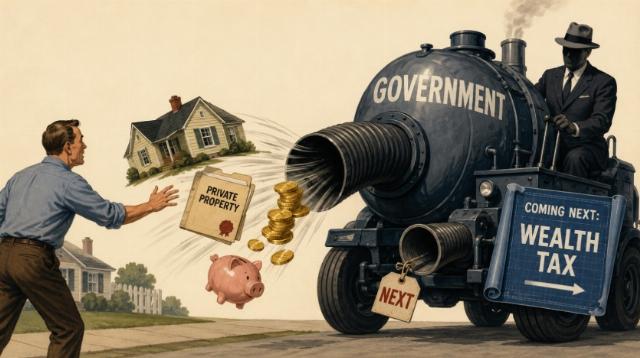
Private Property Confiscation
Since Franklin Roosevelt, federal and state governments have slowly but surely claimed that property is a privilege, not a right. The wealth tax is the next step.
BY: Allan J. Feiffer, The American Thinker (August 21, 2026).
Americans traditionally understood that what they owned was theirs, not the government’s. Yet, over the last century, that principle has steadily eroded—from gold confiscation to civil asset forfeiture to proposed wealth taxes. The emerging principle is stark: Your property is yours only to the extent that the State allows you to keep it.
Preliminarily, what does it mean to own something? In America, the traditional answer was straightforward: it meant that the property was yours—not the government’s—and that the State had no claim to it unless you forfeited it through a criminal act or the government seized it through eminent domain for the public good.
Private property was understood as an extension of individual liberty, protected by right and law rather than being a privilege that the government granted at its discretion. That principle was deeply embedded in the American tradition and helped distinguish a free citizen from a subject of the State. That relationship changed dramatically in the 20th century.
Perhaps the most well-documented exercise of government power over private property occurred in 1933, when Franklin Roosevelt issued Executive Order 6102, requiring Americans to surrender most of their monetary gold to the government at the then-fixed price of $20.67 per ounce. Those who failed to comply faced criminal penalties.
The following year, the Gold Reserve Act of 1934 placed monetary gold under federal ownership and raised the official price of gold to $35 an ounce—a nearly 70 percent increase from the $20.67 price at which Americans had been required to surrender their gold. Whatever the legal justification, the episode demonstrated something deeply unsettling about the power of the State: It could declare lawful property impermissible to own, compel its sale to the government at a price it dictated, and then change the official value of that property after acquiring it. By any ordinary understanding, that is confiscation backed by the power of the State.
The next expansion came with the institutionalization of modern civil forfeiture. Civil forfeiture originated in an old maritime and customs doctrine and has become a powerful and controversial domestic instrument of government.
Federal forfeiture authority expanded significantly in 1978 and 1984, when Congress broadened the government’s ability to seize the proceeds of alleged drug crimes and property used to facilitate them. The Comprehensive Crime Control Act of 1984 also established the Department of Justice’s Assets Forfeiture Fund and authorized the Attorney General to share forfeited property with state and local law-enforcement agencies.
This created a profound change in the incentives driving police and regulatory agencies. Property could be seized and forfeited without the government necessarily obtaining a criminal conviction against its owner, and law-enforcement agencies could benefit from the property they seized, much as pirates did.
Owners who had not been convicted of—or even charged with—a crime could find themselves fighting to recover money, vehicles, homes, and other property in proceedings in which the government was pursuing the property rather than proving the owner’s criminal guilt.
America is a country of precedent. Once the government established the precedent that it could seize private property without first convicting—or even charging—the owner of a crime, and sometimes without even obtaining a warrant, the process felt like an illegal taking. Today, federal forfeiture alone is a multibillion-dollar enterprise. In fiscal 2025, the Justice Department’s Assets Forfeiture Fund received $2.287 billion in forfeiture proceeds, following $2.422 billion in 2024 and $3.339 billion in 2023.
It’s not just the Feds, either. States have developed their own civil asset forfeiture systems, allowing law enforcement agencies to seize property alleged to be connected to criminal activity and, after forfeiture, retain or spend the proceeds.
Florida provides a particularly revealing example. Its Contraband Forfeiture Act expressly authorizes law-enforcement agencies to use forfeiture proceeds as “supplemental funding.” State law directs forfeiture proceeds into law-enforcement trust funds, while federal asset-sharing programs provide another avenue for state agencies to receive proceeds from federal forfeitures. What began as an extraordinary power to take property associated with crime has evolved into a nationwide system in which government agencies have a vested financial interest in the property they seize.
Not every exercise of forfeiture or taxation is unconstitutional or illegitimate. The government has always possessed some authority to take property under the law. The question is where the boundary lies—and whether each expansion of that authority comes close to an extra-judicial taking.
Even with all this hanky-panky, the government’s reach apparently isn’t broad enough. Now states and the federal government are contemplating the next rung up the ladder: outright wealth confiscation.
There is a fundamental difference between government taking property because it claims the property was involved in a crime and government taking property simply because someone possesses it. The former at least purports to rest on an allegation of wrongdoing. The latter rests on the government’s assertion that it has a legitimate claim to something you’ve earned.
Once government moves from taxing what we earn to taxing what we own, ownership itself becomes the taxable event. The government no longer must point to a transaction, an offense, or even a particular act that generated the property. The mere fact that you possess it is enough to establish a first lien on your wealth.
And this is no longer theoretical. In March 2026, Senator Bernie Sanders and Representative Ro Khanna introduced legislation imposing a 5 percent annual tax on billionaires’ wealth. California voters will also decide in November whether to impose a one-time five-percent tax on the net worth of qualifying billionaires. California’s Legislative Analyst describes the measure as a tax on wealth, defining wealth as the value of what a person owns, less his debts.
Remember our discussion of precedent earlier? We’ve now arrived at the heart of the matter.
Whether government takes 5 percent, 50 percent, or ultimately 100 percent, the amount is a question of degree. The underlying concept that property is only conditionally yours is the more important issue.
The fundamental question is whether government has a legitimate claim to property simply because a citizen possesses it. Once the answer becomes yes, the government—not the owner—ultimately determines how much of that property the “owner” is permitted to keep.
Calling it a tax does not change the underlying assertion of power: the State is effectively placing a lien on property that you own.
And history suggests that the government rarely leaves a newly established power confined to its original boundaries. The justification will always be that the next confiscation is different, that the next group is different, or that the next need is greater.
The government does not have to begin by taking everything. It merely must establish the principle that it can take something that was previously understood to belong entirely to the individual and declare that a portion of it belongs to the State.
Once ownership is deemed conditional, private property ceases to be a protected right. That is the real issue. It is not how much wealth the government takes; it is whether we are willing to accept the proposition that the government has a claim to wealth simply because we possess it. Because once that principle is accepted, the question is no longer whether the government can take your property; it is how much of it the government will allow you to keep.
Did someone say “Communism”?
God Bless America.
____________________________________________________________________
When Lenin Lost An Election, He Abolished Democracy
When revolutionary socialists tell us who they are, perhaps we should take them at their word.
BY: Charlton Allen, The American Thinker (August 21, 2026).
History remembers revolutions for their explosions.
Think of the French Revolution, and the storming of the Bastille comes quickly to mind. The American Revolution has Lexington and Concord. Russia’s revolution is remembered through darker images: armed Bolsheviks in Petrograd, the cruiser Aurora and the fall of the Winter Palace, the slaughter of the Romanovs at Ekaterinburg, Perm, Alapayevsk, and the Peter and Paul Fortress—and then the Red Terror.
One of its most consequential moments, however, came with almost no drama at all.
In the early morning of January 19, 1918, exhausted deputies sat inside Petrograd’s Tauride Palace after a session that had stretched through the night. Millions of voters had elected them to a Constituent Assembly charged with determining the political future of a state emerging from war, revolution, and imperial collapse.
Suddenly, an armed sailor informed them that the proceedings were over.
The explanation attributed to Anatoly Zheleznyakov became famous: the guard was tired. It seemed innocuous enough. Tomorrow was another day.
The deputies gathered their papers and left.
But there was no tomorrow.
The Constituent Assembly—the former empire’s grand experiment in representative democracy—had survived for a single day.
This quiet shuttering of Russia’s parliamentary experiment deserves to rank among the defining events of the Russian Revolution.
The Bolsheviks had already demonstrated that they could seize power. Now they confronted a more important question: having taken power in the name of workers and peasants, would they permit the people themselves to determine who governed?
The answer was an emphatic no.
The Constituent Assembly was not a Bolshevik invention. For decades, opponents of Romanov autocracy had demanded an elected body empowered to determine the country’s constitutional future.
Liberals wanted it. Socialists wanted it. The Provisional Government promised it. The Bolsheviks themselves demanded it. As late as December 1917, Lenin acknowledged that no institution then known was better suited to “determining the will of the people.”
Even the monarchy’s final prospective ruler deferred to it.
When Nicholas II abdicated in March 1917, the succession passed nominally to his brother, Grand Duke Michael Alexandrovich. Michael declined to exercise supreme authority unless a popularly elected Constituent Assembly determined the new political order.
There is a constitutional irony here almost too extraordinary to ignore.
The last prospective Romanov was willing to make his authority contingent upon an elected assembly.
Ultimately, Lenin was not.
A brief note on terminology matters. Historians conventionally call these events the “Russian Revolution,” but the old Russian Empire was already disintegrating. Its electorate encompassed Russians, Ukrainians, Belarusians, Baltic peoples, Georgians, Armenians, Tatars, Jews, Muslims, and many other communities—some of which were already asserting or declaring independence.
The same complexity existed on the socialist side. Lenin’s Bolsheviks were only one faction competing for the revolutionary future. Mensheviks and Socialist Revolutionaries had their own constituencies, programs, and claims to speak for workers and peasants.
The election itself was extraordinary by the standards of Russian history. Women cast ballots—before nationwide women’s suffrage in the United States. So did soldiers, peasants, and workers. Millions who had lived as subjects of the tsar were suddenly being asked, however imperfectly, to help decide what political order would replace him.
The result was disastrous for the Bolsheviks, who had seized power only weeks earlier.
The Socialist Revolutionaries emerged as the largest political bloc, while the Bolsheviks received roughly a quarter of the national vote. Bolshevik strength was considerable in Petrograd, Moscow, and among important urban and military constituencies.
Before the Assembly even convened, the Bolshevik government had outlawed the liberal Constitutional Democrats, or Kadets, formally branding the party an “enemy of the people” after the moderate party had won more than a third of the vote in Moscow.
There was, however, a problem with the result.
The Socialist Revolutionary candidate lists had largely been prepared before the widening rupture between the party’s Left and Right wings had fully crystallized. Left Socialist Revolutionaries would initially align with the Bolsheviks, while their former comrades on the Right opposed Bolshevik rule. Lenin pointed directly to this mismatch between rapidly changing political realities and the older candidate lists.
But if Lenin believed voters had been deprived of a meaningful choice between Left and Right Socialist Revolutionaries, the democratic remedy was obvious: return the question to the people.
Hold another vote.
Let the factions campaign separately. Let the Bolsheviks argue that events had vindicated them. Let workers, peasants, soldiers, and the rest of the electorate decide again.
Or let the factions sort matters out in the Assembly and see whether a governing majority could emerge.
As late as December 1917, Lenin publicly dismissed as “absolutely false rumours” reports that the Constituent Assembly would not be permitted to convene.
Yet Lenin—never one to let a crisis go to waste—chose something else altogether.
He did not merely challenge the election’s mechanics. He challenged the authority of parliamentary democracy itself.
In his These on the Constituent Assembly, Lenin declared the Soviet republic a “higher form of democracy” than the parliamentary republic elected by the people. His argument placed the interests of the socialist revolution above the ordinary claims of parliamentary legitimacy.
Representative democracy rests upon an uncomfortable proposition: voters have the right to choose badly.
Politicians may believe the electorate misguided. They may regard their opponents as foolish, dishonest, dangerous, or ruinous. But democratic government requires that political power ultimately answer to the people.
Lenin reversed the relationship.
The revolutionary vanguard claimed to understand the authentic interests of workers and peasants, even when those workers and peasants cast ballots producing an inconvenient result. The Party represented the people because it understood their true historical interests. If the electorate chose differently, its verdict could not be allowed to obstruct those interests.
The less the electorate’s actual verdict mattered, the “higher” the democracy became.
It was democracy usurped.
When the Constituent Assembly convened, Socialist Revolutionary Viktor Chernov was elected its leader. The Assembly refused to ratify Bolshevik supremacy. The Bolsheviks walked out. The Left Socialist Revolutionaries followed.
The remaining deputies kept working.
That was the problem for Lenin and his allies: the Assembly was exercising authority independent of the Bolshevik government.
By morning, the guards ended the experiment.
The great institution demanded for decades by opponents of autocracy was gone after a single sitting.
The destruction of the Constituent Assembly illuminates something fundamental about revolutionary Marxism.
Marxism was never a platform for change at the margins. It is a revolutionary project on a grand scale: the transformation of property relations, class structures, political institutions, and the existing social order.
Such a project does not readily yield to an electoral setback.
What happens when voters say no?
January 1918 supplied an unmistakable answer.
The Bolsheviks placed revolutionary legitimacy above electoral legitimacy. Once that principle was established, political opponents could cease to be fellow citizens who might win the next election and instead become enemies of the Revolution.
Soon Left Socialist Revolutionaries became enemies. Mensheviks became enemies. Later, Trotskyists became enemies. Eventually, veteran Bolsheviks themselves would be accused of conspiring against the state.
Independent religious authority would meet the same intolerance. Clergy and the devout were prosecuted—even executed—as counterrevolutionaries. Churches, monasteries, and convents were seized, closed, repurposed, or destroyed.
The regime eventually backed a compliant “Living Church” as a rival to traditional Orthodoxy. Its very name carried the revolutionary conceit: if this was the “living” Church, the old Church—and the old ways it embodied—were expected to die.
None of those later developments was inevitable in January 1918. Civil war, assassination, foreign intervention, and conspiracies—genuine or not—would shape what followed.
But the precedent was firmly established: the Revolution recognized no independent authority with an inviolable claim to stand in its way.
There is a lesson here that should resonate in our own age. Marxist movements have long spoken the language of democracy.
Lenin certainly did. So did governments that followed in his ideological tradition.
Communist constitutions invoked popular sovereignty, elections, “people’s democracy,” and government in the name of workers and peasants. Even the names of one-party states frequently appropriated the vocabulary of democratic legitimacy: Democratic Republics, People’s Republics—governments claiming to embody the authentic will of the people.
The conundrum was not the absence of democratic rhetoric. It was what happened when actual voters, institutions, churches, political parties, or other independent centers of authority refused to validate the revolutionary project.
Democracy was celebrated when it advanced the Revolution. When voters challenged the consolidation of Bolshevik power, democracy was swept aside.
If voters rejected the Bolsheviks, the problem was not necessarily the Revolution—it was the voters. The vanguard claimed authority to distinguish the people’s “true” interests from the choices the people actually made.
Once those in power reserve the right to decide when voters’ expressed wishes are authentic, democracy ceases to constrain government.
Instead, government constrains—or eliminates—democracy.
For decades, revolutionaries had demanded that the peoples of the old Russian Empire be permitted to determine their political future.
The Constituent Assembly would not be the last independent institution to discover that the Bolshevik Revolution recognized no authority higher than itself.
It was the first.
____________________________________________________________________
Communism, McCarthyism, and the New Red Scare
James Burnham saw how communist tactics turned criticism of communism into an accusation of political extremism.
BY: Francis Sempa, The American Spectator (August 17, 2026).
As outspoken socialists gain more influence by winning elections at all levels of government in the United States, the Left and its media allies warn of “McCarthyism” and the “new red scare” whenever conservatives recount socialism’s dismal history in power. This is an old communist tactic that the great student of communism James Burnham recognized at the height of the anti-McCarthy frenzy in the 1950s.
Burnham broke with communism in 1940 and began writing for Partisan Review, a journal of the anti-communist left. In 1953, Burnham cut his ties to Partisan Review over the issue of domestic communism and communist infiltration of the U.S. government and society. In his resignation letter to his former colleagues at Partisan Review, Burnham wrote that the term “McCarthyism” was “an invention of … Communist tacticians” who wielded it as “diversionary semantics” to undermine congressional efforts to investigate domestic communism.
Socialism, to borrow F.A. Hayek’s phrase, is the “road to serfdom.” The Left’s invocation of a “new red scare” is designed to disguise that truth.
The next year, Burnham wrote a compelling book titled The Web of Subversion that detailed the revelations of congressional committees and witnesses such as Whittaker Chambers and Elizabeth Bentley about communist activities in the United States. Today, as openly socialist candidates seek political power at the ballot box with some success, the far Left runs interference for them using similar “diversionary semantics.”
Professor Theodore Zorn in The Conversation warns that “another Red Scare” may be taking over America. Zachary Wolfe on CNN’s website claims that the “modern-day Red Scare is officially here.” The Nation headlines Chris Lehman’s recent piece, “The GOP’s New Red Scare,” complete with a photo of Sen. Joe McCarthy. Columbia Magazine featured a story about a panel of descendants of American communists who warned that today’s “‘enemy of the state’ rhetoric” is reminiscent of the Red Scare of the 1950s. Terrence Petty, writing in the Forward, claims that President Trump is fomenting a “new red scare,” which endangers us all, but especially American Jews. Qian He, a sociology professor at the Chinese University of Hong Kong, invoked “McCarthyism” to describe a “pervasive climate of fear” being stoked by the Trump administration and directed at China. Not to be outdone, MS Now’s Michael Steele, in an article featuring a photo of McCarthy and Trump, accuses the president of trying to start a “new Red Scare.” The staff of the Democratic Strategist contends that the “Red Scare has returned to America.”
Of course, the so-called Red Scare of the late 1940s and early 1950s was based on the reality of extensive communist infiltration of our government and other institutions. Burnham’s The Web of Subversion detailed some of it. Whittaker Chambers gave us an inside view of domestic communism in his masterpiece, Witness. Harvey Klehr and Ronald Radosh revealed the extent of communist infiltration of the State Department in The Amerasia Spy Case. Herbert Romerstein and Eric Breindel explored the revelations of the Venona papers in The Venona Secrets. M. Stanton Evans showed the truth underlying McCarthy’s and the FBI’s investigations of domestic communists in Blacklisted By History. Diana West’s American Betrayal further exposed communist penetration of our government and institutions. Even liberal Washington Post writer Nicholas von Hoffman acknowledged in 1996 that Sen. McCarthy “was … closer to the truth than those who ridiculed him.”
During the so-called Red Scare, it was revealed that communists and communist sympathizers and agents of influence included high-level Treasury Department officials, OSS officers, high-level State Department officials, and even a White House staffer or two.
There were many more in the bowels of federal agencies. Communists infiltrated union, as then-Screen Actors Guild president Ronald Reagan discovered. Meanwhile, as Paul Hollander detailed in his book Political Pilgrims, non-communist leftist intellectuals envisioned a utopian future under communism.
Today’s socialists, of course, don’t embrace being linked or likened to communists, but we should all remember that shortly after Vladimir Lenin seized power in Russia in 1917, he exclaimed, “We shall now proceed to construct the socialist order.” And we should also remember the words of Winston Churchill in 1945:
[T]here can be no doubt that Socialism is inseparably interwoven and the abject worship of the State … liberty in all its forms is challenged by the fundamental conceptions of Socialism … Socialism is, in its essence, an attack upon the right of the ordinary man or woman to breathe freely without having a harsh, clumsy tyrannical hand clapped across their mouths and nostrils … [N]o Socialist system can be established without a political police.
The most powerful “socialist” country in the world today is the People’s Republic of China, ruled since 1949 by the Chinese Communist Party. It is also the most murderous regime in human history and the principal threat to the security of the United States. Socialism, Lee Edwards wrote, is a “pseudo-religion grounded in pseudo-science and enforced by political might.” Socialism, to borrow F.A. Hayek’s phrase, is the “road to serfdom.” The Left’s invocation of a “new red scare” is designed to disguise that truth.
GFK

