GOOD MORNING FRANK! Drive safely! Have fun! Drink good beer!
Ford is still here. He is becoming quite the local. He has gone tubing, hiking, visited the Burwell-Morgan grist mill, and The Locke Store. He even went to the Drive-In Theatre in Stephens City. Tonight we are all going to Bev Byrd’s farm to watch the fireworks. For some reason, Clarke County’s fireworks are always on July 3.
“My God! How little do my countrymen know what precious blessings they are in possession of, and which no other people on earth enjoy!”
–Thomas Jefferson.
I think that Thomas Jefferson’s comments would be spot on today. We are, as a people, so ignorant and unmindful of what blessings we enjoy, and how our government is supposed to function. We are ungrateful for our abundance, impatient and unrealistic in our expectations, and insufficiently serious in our conduct. May we all strive to improve.
The ‘Fourth of July’ is not good enough
I honestly cannot recall hearing anyone in the last few weeks referring to it as Independence Day.
BY: Kevin Finn, The American Thinker (June 27, 2026).
Every year, as summer heats up, I find myself gently correcting friends and family. Plans fly back and forth: “What are you doing for the Fourth?” “Hoping for good weather on the Fourth!” It’s a small thing, but it irritates me.
This year is worse than ever. I honestly cannot recall hearing anyone in the last few weeks referring to it as Independence Day. There have been many ads on television, radio, the internet, and in the newspaper referring to the upcoming holiday, and I haven’t seen one of them referring to it by name.
We don’t wish people a “Merry December 25th” or a “Happy January 1st.” Yet this holiday, and only this one holiday, is routinely reduced to its calendar date. That habit matters more than it seems, because it risks dimming the very reason we celebrate.
The Declaration of Independence, drafted primarily by Thomas Jefferson and formally adopted by the Continental Congress on July 4, 1776, was an audacious act. Thirteen colonies declared themselves free from the most powerful empire on Earth. They staked everything on the radical idea that governments derive their just powers from the consent of the governed, and that all men are endowed by their Creator with unalienable rights to life, liberty, and the pursuit of happiness.
Calling the anniversary Independence Day keeps that revolutionary spirit front and center. It honors the courage of the Founders and the countless men and women who risked (and often lost) their lives, fortunes, and sacred honor to make those words real. It reminds us that the United States was not handed down by accident, but deliberately founded on timeless principles of liberty and self-government.
By contrast, “the Fourth of July” sounds like just another date on the calendar — pleasant but weightless. It easily slides into a generic summer holiday of barbecues, fireworks, and long weekends. Those traditions are wonderful, but without the deeper context, the celebration can drift away from its roots in defiance, sacrifice, and the birth of a sovereign nation.
Independence Day also connects us to a broader human story. Countries around the world proudly mark their own independence days — India on August 15, Mexico on September 16, Nigeria on October 1, and many others. The phrase signals liberation from colonial rule or tyranny and affirms the universal yearning for self-determination. When Americans use the same language, we both highlight our own unique founding and stand in solidarity with that global aspiration for freedom.
Today, far too many of our county’s foundational ideas feel contested or taken for granted. Recently, we’ve seen freshman politicians boasting about wiping their dirty hands on the American flag, openly denigrating America, and even supporting Muslim terrorists.
In light of that, reclaiming “Independence Day” is powerful. It invites reflection: Are we still living up to the principles Jefferson articulated? Are we teaching the next generation what that extraordinary summer of 1776 actually meant? Some of us are, but far too many of us are not. The name itself calls us to remember, to recommit, and to pass the legacy forward.
“The Fourth” feels static and forgettable. Independence Day pulses with meaning. It keeps the holiday anchored in history, ideals, and purpose.
Moving forward, let’s make the small but meaningful shift. Say it, celebrate it, and teach it as Independence Day. Gently remind others of the real name of this holiday. In doing so, we honor the courage that gave us this country and help ensure its spirit endures.
This is more important now than ever.

____________________________________________________________________
America’s 250th birthday asks what freedom still means
The Founders’ vision now battles socialism, debt and cultural surrender
BY: Don Feder, The Washington Times (June 28, 2026).
On the 250th anniversary of our independence, we should ask what America means.
Commentator Dennis Prager once wrote that, for most countries, the question is irrelevant. England, France and Spain are nations with their own histories and cultures. However, through mass migration, they are being colonized by the Third World.
Still, there are Englishmen who are rightly proud to be English.
Yet to ask what England means now that its empire is gone is absurd. That Britain has had six prime ministers in the past 10 years is a sign of a nation adrift.
America is unique. From our founding, the United States was meant to reflect certain truths: “That all men are created equal, that they are endowed by their Creator with certain unalienable rights, that among these are Life, Liberty and the pursuit of Happiness. That to secure these rights, Governments are instituted among men, deriving their just powers from the consent of the governed.”
That is as much of a revolutionary statement today as it was in 1776.
We went on to offer a model of limited government in the Constitution. We fought two world wars in pursuit of our national purpose and later defended the free world during the Cold War.
We embraced Adam Smith’s free market vision, as set forth in “The Wealth of Nations,” published the year we declared our independence.
From the outset, we were a creedal nation, one based on ideas rather than blood. People came here from all over the world. We were e pluribus unum — out of many, one.
As it was during the Civil War, we are once again engaged in a great struggle to determine which will prevail: the philosophy of the Founders or a darker vision.
The Democratic Party hates America. Only 27% of Democrats intend to display the flag on the Fourth of July this year.
Socialism — an ideology diametrically opposed to the principles of the Founders and a failure everywhere it has been tried — is on the rise. New York and Seattle have socialist mayors. Washington just elected one. In New York City, socialists just won three congressional primaries.
Polls show that a majority of young adults have positive views of socialism. For a dose of reality, they should spend a week in Cuba or Canada.
President Reagan said: “Freedom is a fragile thing, and it’s never more than one generation away from extinction.” This could be that generation.
The leadership of the Democratic Party does not believe in borders. It thinks homelessness is a natural phenomenon and is convinced that crime can be controlled with more social spending.
A Democratic congressional candidate in New York believes that no one should be in prison, including murderers. Far-left Sen. Bernard Sanders, Vermont independent, thinks private property should be taxed out of existence.
The party’s leadership cannot tell you what a woman is, but it will help your son become one.
The national debt is a staggering $39.2 trillion, or $115,000 for each American. It grows by $2 trillion to $3 trillion a year. If the fiscal house of cards we have built ever collapses, we will all be buried in the rubble.
We are governed by career politicians, a notion the Founding Fathers abhorred. President Biden spent 55 years of his life serving in elective office.
Opposing this is an army of patriots of every race, religion and creed. These are people whose hearts beat faster when they see the flag or hear “The Star-Spangled Banner.” Some have worn their country’s uniform. Others have engaged in political warfare for decades.
Some have lineages going back to the Mayflower. Others, such as Secretary of State Marco Rubio, have immigrant parents.
When someone called novelist Ayn Rand a “foreigner,” she replied: “I chose to be an American. What did you do, besides being born here?”
Regardless of where we were born, we all choose to be Americans.
The fate of humanity will depend on the outcome of this struggle. Daniel Webster, the great 19th-century Whig leader, cautioned: “Hold on to your Constitution, for if the American Constitution shall fail there will be anarchy throughout the world.”
If not America, who will stop mankind from marching backward into slavery — old Europe, which has severed its religious roots?
This is our time to stand up for freedom.
As it was with the Colonial militia of 1775, the blue coats on Cemetery Ridge, the soldiers on Omaha Beach and those who fought in muddy fields, jungles and deserts around the world, now it is our turn to sacrifice for America and all mankind.
_________________________________________________________________
Crafting America’s Birth Certificate 250
Jefferson, the Committee of Five, and the making of the Declaration of Independence.
BY: Craig Seibert, The American Thinker (July 1, 2026).
By the summer of 1776, the American colonies had reached a point of no return. More than a year had passed since the battles of Lexington and Concord ignited armed conflict with Great Britain. British troops had occupied Boston, King George III had declared the colonies to be in open rebellion, and hopes for reconciliation were rapidly fading.
In January 1776, Thomas Paine’s Common Sense transformed public opinion by arguing that independence was both practical and morally necessary. By June, several colonial governments had instructed their delegates to support independence. On June 7, Richard Henry Lee introduced his famous resolution declaring that “these United Colonies are, and of right ought to be, free and independent States.”
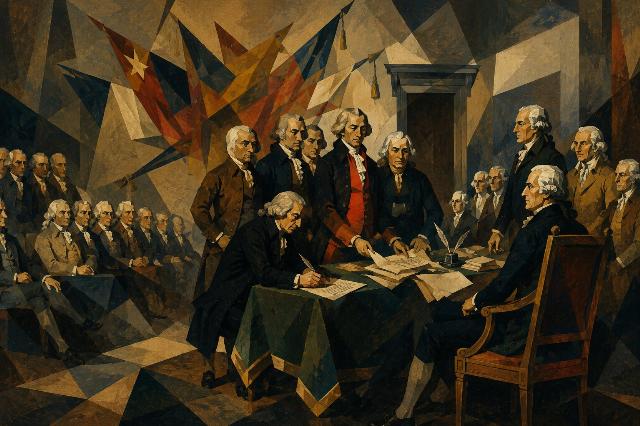
Congress recognized that independence required more than a vote. The world needed an explanation, and future generations needed a statement of the principles upon which the new nation would be founded. On June 11, 1776, the Second Continental Congress appointed a committee to prepare that declaration.
The Committee of Five
The Committee of Five consisted of Thomas Jefferson of Virginia, John Adams of Massachusetts, Benjamin Franklin of Pennsylvania, Roger Sherman of Connecticut, and Robert R. Livingston of New York.
John Adams later explained why Jefferson was selected to write the first draft. Jefferson possessed, in Adams’s words, “a happy talent of composition.” He wrote with uncommon clarity, elegance, and precision. As a Virginian, he also represented the South, giving the document broader acceptance throughout the colonies.
Working in rented rooms on Market Street in Philadelphia, the thirty-three-year-old Jefferson spent nearly two weeks crafting what would become one of the most influential political documents in history.
Every Word Carefully Chosen
Jefferson did not write casually. Drawing upon English common law, colonial declarations, the writings of John Locke, and the natural rights tradition, he carefully selected language that would express timeless truths rather than temporary political grievances.
His greatest achievement was not inventing new ideas but expressing familiar principles with extraordinary power.
He declared that “all men are created equal” and are “endowed by their Creator with certain unalienable Rights.” By grounding rights in the Creator rather than government, Jefferson affirmed that liberty is God’s gift, not a privilege granted by kings or legislatures.
Governments exist not to create rights but to protect those already possessed by every person.
After Jefferson completed his draft, John Adams and Benjamin Franklin suggested only modest revisions. Franklin’s most famous change replaced Jefferson’s phrase “sacred and undeniable” with the now-famous words “self-evident.” The Committee of Five approved the revised draft and submitted it to Congress on June 28, 1776.
Jefferson’s Original Condemnation of the Slave Trade
One of the most significant portions of Jefferson’s original draft never appeared in the final Declaration. In a lengthy indictment of King George III, Jefferson condemned the transatlantic slave trade in some of the strongest language written by any American leader during the Revolutionary era.
The deleted passage deserves to be read in Jefferson’s own words:
He has waged cruel war against human nature itself, violating its most sacred rights of life & liberty in the persons of a distant people who never offended him, captivating & carrying them into slavery in another hemisphere, or to incur miserable death in their transportation thither. This piratical warfare, the opprobrium of infidel powers, is the warfare of the Christian King of Great Britain. Determined to keep open a market where MEN should be bought & sold, he has prostituted his negative for suppressing every legislative attempt to prohibit or restrain this execrable commerce; and that this assemblage of horrors might want no fact of distinguished die, he is now exciting those very people to rise in arms among us, and to purchase that liberty of which he has deprived them, by murdering the people upon whom he also obtruded them: thus paying off former crimes committed against the liberties of one people, with crimes which he urges them to commit against the lives of another.
Jefferson argued that the Crown had repeatedly prevented colonial legislatures from restricting or ending the importation of enslaved Africans. Several colonies, including Virginia, had attempted to limit the trade, only to have their laws vetoed by royal authority. (This meant that even those who wanted to free their slaves could not.)
Why Congress Removed It
The Committee of Five did not delete Jefferson’s anti-slavery passage. After only minor editorial changes by Adams and Franklin, the draft went before the full Continental Congress.
During debates between July 1 and July 4, delegates from South Carolina and Georgia strongly objected to the language because their economies depended heavily upon the continued importation of enslaved laborers. Some northern delegates also represented commercial interests that had profited from the slave trade and were unwilling to condemn practices connected to their own regions.
To preserve the fragile unity needed to declare independence, Congress removed the entire passage.
Jefferson later expressed disappointment over the deletion, but the delegates believed unanimous support for independence was essential. They chose national unity over language that might have divided the colonies before the Revolution had even been won.
Congress Strengthens the Declaration
Between July 1 and July 4, Congress debated Jefferson’s draft line by line, making approximately eighty-six changes. Roughly one-fourth of his original wording was revised or deleted. Most edits simplified sentences, softened rhetoric, or clarified meaning.
Although Jefferson disliked many of the revisions, Congress preserved every foundational principle. The Declaration continued to proclaim that rights come from the Creator, governments derive “their just powers from the consent of the governed,” and the people retain the right to alter or abolish governments that become destructive of those rights.
Those principles formed the enduring heart of the document.
Adoption and Signing
On July 2, 1776, Congress approved Richard Henry Lee’s resolution, declaring the colonies independent. John Adams believed Americans would forever celebrate July 2 as the nation’s great anniversary.
Instead, history remembers July 4—the day Congress approved the final wording of the Declaration of Independence.
Most delegates signed the engrossed parchment on August 2, although several added their signatures later. By signing, they knowingly committed what Britain considered high treason, punishable by death. They pledged to one another “our Lives, our Fortunes and our sacred Honor,” fully aware of the risks they were accepting.
A Legacy That Changed the World
The Declaration of Independence did far more than announce America’s separation from Great Britain. It proclaimed universal principles that have inspired movements for liberty around the world for nearly 250 years.
Jefferson’s remarkable prose, Franklin’s wisdom, Adams’s counsel, the Committee of Five’s review, and Congress’s careful revisions combined to produce one of history’s greatest statements of human freedom.
Although written by imperfect men, the Declaration’s central truths have endured: that our rights come from the Creator; that governments exist by the consent of the governed; and that liberty is worth defending, even at the greatest personal cost. Those principles remain the foundation of the American experiment and one of the nation’s greatest gifts to the world.
____________________________________________________________________
Declaration of Independence – A reminder of its importance
Do we really understand the weight and implication of what those 56 men brought into existence in 1776?
BY: Christian Vezilj, The American Thinker (June 29, 2026).
The Declaration of Independence remains one of the most important documents ever written, not only in American history but in the history of human freedom. As the United States approaches its 250th birthday, it is worth pausing, reflecting, and truly considering what the Declaration says — and why it changed the course of human civilization. Most people can quote a few lines from it, but very few stop to think about the deeper meaning behind those words or the extraordinary claim the Founders made about the source of our rights.
The Declaration of Independence is the only national founding document in the world that clearly identifies the source of human rights. It does not say rights come from kings, governments, parliaments, or any human institution. It does not say rights are granted by majority vote or political power. Instead, it declares that human beings are “endowed by their Creator with certain unalienable Rights.” That single sentence is the foundation of American freedom.
This idea was revolutionary in 1776, and it remains revolutionary today. If rights come from God — from a higher moral authority — then they are permanent. They cannot be changed, rewritten, suspended, or taken away by any government. They are not privileges. They are not favors. They are not temporary. They are unalienable, meaning they cannot be surrendered or removed because they are woven into the very nature of being human.
By contrast, if rights come from government, then they are fragile. They can change from administration to administration. They can be expanded or restricted depending on political winds. They can be granted one day and taken away the next. History shows that governments that claim to “give” rights almost always end up taking them away. When rights come from government, freedom becomes conditional — something you have only as long as those in power allow it.
The Founders understood this danger. They had lived under a system where rights were treated as privileges granted by a monarch. They saw how easily those privileges could be abused, limited, or revoked. So they made a bold and unprecedented declaration: government does not create rights; government exists to protect rights that already exist. This is the heart of the American experiment.
Because of this principle, life in the United States is fundamentally different from life in any other nation. Americans are born free. Freedom is not something we earn, negotiate, or request. It is our inheritance. It is our birthright. It is the starting point of American life, not the reward. No other country puts this truth into writing the way the Declaration of Independence does. Many nations talk about rights, but only the United States defines their source — and places that source above government.
As America celebrates its 250th anniversary, it is important for every citizen to reflect on this truth. Our freedoms — speech, religion, assembly, self‑defense, due process, and the pursuit of happiness — are not gifts from politicians. They are not granted by courts. They are not created by Congress. They come from God, and because they come from God, they cannot be taken away by man.
The Declaration of Independence is not just a historical document. It is a reminder, a warning, and a promise. It reminds us that freedom is sacred. It warns us that government must always be limited. And it promises that as long as Americans remember where their rights come from, they will remain a free people.
GFK


Thanks!
Sent from Yahoo Mail for iPhone
LikeLike